Feeling a bit let down by my M&P 9 Pro, I bought a CZ P-09 Duty a few weeks ago. I've since put about 650 rounds through it, mostly my own 125gr LCN hand loads. I very recently added the Cajun Gun Works short reset kit, oversize DA roller, and reduced power hammer spring. I put 300 rounds through it with this kit installed, the rest being fired before I made any modifications at all.
Well, I like this gun very much, and would emphatically recommend it for anyone looking to either get started in any sort of competition, or anyone looking for a full-sized 9x19mm service pistol or bedside gun. It's just very good. You can stop reading here if you're pressed for time, because what follows is just expounding on these statements.
Right out of the box, the Omega trigger has a very good double action pull, and the single action is long and light with a sharp break at the very end of the pull. There was a tiny bit of overtravel, but not enough to be really concerned about. The reset is quite long, and that is a little worrying if you're shooting against the clock. Otherwise, it's not a deal breaker. The CGW parts make the double action really quite good, and sets the single action pull a little closer to the break, and erases any overtravel. The short reset kit cuts the reset down to less than half of the factory trigger. I would recommend getting the parts I listed, but only if you're seriously into competing. If you're just getting started, you can skip it and spend the money on magazines, a good belt, holster, and pouches.
I've also found the P-09 to be very accurate, and easy to shoot well. The main thing I didn't like about my M&P was that I seemed to always be mind-wrestling it to stay in control. Not so with the P-09, but that's more down to my personal preferences. That being said, I much prefer the P-09 and find it easier to make better hits at longer ranges. I can now clean off James's plate rack from 25 yards as long as I look at my sights. This was an exercise in frustration with the M&P.
My own feelings aside, the P-09 seems to be very accurate, and has unique recoil characteristics that make it pretty ideal as a race gun. It has almost no muzzle flip, and not much in the way of felt recoil. It's just very nice to shoot. Just for fun, James and I did some slow motion video of the P-09 with the factory guide rod and spring, and a tungsten unit meant for a Glock. I also shot James's G34 with said tungsten unit. The results are below:
Aside from the accuracy, negligible muzzle flip, and good trigger, the P-09's frame has some nice design features. There's a little stippled pad midway down the frame on both sides. These are great places to park your reaction side thumb and trigger finger. The magazines are very long, and have nice bumper pads. It's as easy, if not easier to reload than the M&P. It's also very easy to install those CGW parts. The P-09 is probably the least complicated DA/SA pistol I've ever taken apart. Check this video if you're thinking of getting a P-09 and installing the kit yourself.
The P-09's only real problem is the CZ SP-01 Shadow. I've shot a "Cajunized" Shadow, and it was brilliant. Probably the best handgun I've ever shot. But it is, before any modifications, over $1000. The P-09 is less than $500, and the CGW kit I bought was about $135 shipped. So for about half the money, you can get about 90% of the capability of the Shadow. For someone like me, coming from a long line of farmers, the price difference is not easy to overlook. If you have the money, and you already compete or you have a taste for expensive guns, get the Shadow. For everyone else, the P-09 is way more gun than you pay for.
Sunday, April 19, 2015

Wednesday, April 8, 2015
I Felt Threatened
"I felt threatened" has become the tag line that is driving a very solid wedge between police and the communities they serve. I don't want this to be a political blog, but I saw a video this morning that motivated me to write something in hopes the police community might one day see it.
There's video of a South Carolina officer who shoots an old man as he lightly jogged away, then a second officer plants an object near where the victim fell. This is pretty clear, and thankfully, the officer involved has been charged with murder. The excuse for the shooting was "I felt threatened".
Closer to home, a woman in Burlington, Iowa was accidentally shot and killed by an officer who "felt threatened" by the woman's dog. The officer slipped and fired twice as he fell. He claims the dog took him down, but the P.D. was unable to show medical records, photographs, or even a torn uniform in support of the dog attack claim.
Ladies and gentlemen of the police community, we have a problem. Or rather, two problems.
First and foremost, stop feeling threatened by EVERYTHING. I understand that police work is dangerous. I was a police officer for several miserable months. I was also an infantryman, and did two tours in a particularly bad neighborhood of Afghanistan. I'm no stranger to hazardous work, nor being on the wrong end of a gun. You officers of the law need to learn a new catch phrase. One that I think might do nicely belongs to Travis Haley: "Thinkers before shooters."
Think before you pull the trigger. That's all I'm asking. Do a quick mental risk assessment. Is the risk of using your gun greater than the risk of not using it? In the Burlington case, the officer was allegedly trying to avoid getting bitten by the dog. I get that a dog, especially a big dog, can do serious and even life-threatening damage. But what about pulling the trigger? Where will that bullet actually stop (rule 4: Identify your target, and what is beyond it)?
That leads me to the second problem. The police community refuses to punish officers who act recklessly. The officer in Burlington will face no disciplinary action whatsoever. None. He killed an innocent person and will face no punitive action. Other cops need to step up and denounce this guy (and others like him) and his poor judgement. Police need to shun officers who put the public at risk, and make it known that there will be no "Blue Wall of Silence" for officers who betray the public trust.
Start speaking out before public trust is totally gone (and it's nearly there now). I have friends who are still officers and I want them to be seen as defenders of their communities. Acts like those outlined above make the police as a whole seem reckless, if not bloodthirsty. I know that's not the case. So from now on, all you policemen who read this, think before you shoot. And if a colleague is acting a fool, correct them before they end up as the next headline.
There's video of a South Carolina officer who shoots an old man as he lightly jogged away, then a second officer plants an object near where the victim fell. This is pretty clear, and thankfully, the officer involved has been charged with murder. The excuse for the shooting was "I felt threatened".
Closer to home, a woman in Burlington, Iowa was accidentally shot and killed by an officer who "felt threatened" by the woman's dog. The officer slipped and fired twice as he fell. He claims the dog took him down, but the P.D. was unable to show medical records, photographs, or even a torn uniform in support of the dog attack claim.
Ladies and gentlemen of the police community, we have a problem. Or rather, two problems.
First and foremost, stop feeling threatened by EVERYTHING. I understand that police work is dangerous. I was a police officer for several miserable months. I was also an infantryman, and did two tours in a particularly bad neighborhood of Afghanistan. I'm no stranger to hazardous work, nor being on the wrong end of a gun. You officers of the law need to learn a new catch phrase. One that I think might do nicely belongs to Travis Haley: "Thinkers before shooters."
Think before you pull the trigger. That's all I'm asking. Do a quick mental risk assessment. Is the risk of using your gun greater than the risk of not using it? In the Burlington case, the officer was allegedly trying to avoid getting bitten by the dog. I get that a dog, especially a big dog, can do serious and even life-threatening damage. But what about pulling the trigger? Where will that bullet actually stop (rule 4: Identify your target, and what is beyond it)?
That leads me to the second problem. The police community refuses to punish officers who act recklessly. The officer in Burlington will face no disciplinary action whatsoever. None. He killed an innocent person and will face no punitive action. Other cops need to step up and denounce this guy (and others like him) and his poor judgement. Police need to shun officers who put the public at risk, and make it known that there will be no "Blue Wall of Silence" for officers who betray the public trust.
Start speaking out before public trust is totally gone (and it's nearly there now). I have friends who are still officers and I want them to be seen as defenders of their communities. Acts like those outlined above make the police as a whole seem reckless, if not bloodthirsty. I know that's not the case. So from now on, all you policemen who read this, think before you shoot. And if a colleague is acting a fool, correct them before they end up as the next headline.
Tuesday, March 24, 2015
Still Working On My Masterpiece
Last Sunday was the second match of the year. Between these first two matches I can draw some potentially useful conclusions for others who might be climbing their way up the classifiers or just getting started.
All that bullseye practice has helped my accuracy, but only when I take the time to look at my sights. Dry fire and pellet gun practice are really great, but one piece of the puzzle I forgot was pacing. Witness a fast failure from my first match.
I finished that stage in about 12.5 seconds, but I had almost no A zone hits. The problem was that I had the gas pedal mashed to the floor in order to hang with a particularly talented Production class shooter I wanted to beat, and an Open class guy I thought I could catch. Unfortunately, I needed to slow down just a hair--maybe add another two seconds--and get my A zones. Not only are good hits a great idea in real life, but A zones move your name up the list (provided you're not slow). I learned my lesson that day, and resolved to use my brain parts to think about when to go fast and when to go slow.
So here's stage 1 from last Sunday:
There were a lot of mistakes here (shuffling feet, bad reload, shooting on the move when I should have just posted up) but my pacing was good, and was down two Cs in 12.48. I was less than one second and one A behind the stage winner, who was shooting Open class major power factor.
Besides pacing yourself, and switching between target focus and front sight focus, strategies for shooting steel differ from shooting paper. Behold a spectacular meltdown;
So the problem here is that I over-swung the popper on the draw, then over-swung the first plate, then tried to go faster to make up time and missed more. Reloads weren't bad, but that wasn't enough to save the stage. The trick with steel is to SLOW DOWN and get your hits. Make your transitions smooth and don't swing past the next target. Stay cool if you miss. I melted down and blew the stage. At least I know what I did and can fix it next time.
The good news is that most of what I learned last year hasn't gone away. I won stage 5 pretty handily because Travis Haley is my spirit animal. The only real bad part was that I knew I was fast, and I knew my hits were good, and I almost 180'd my way to a disqualification when I turned around to show the R.O. clear. 14.87 seconds down one C, first place in that stage with the fastest time and most points.
There is NO WAY I could have done that this time last year. The amount of skill I've gained in just one year of competition is incredible. There's no reason anyone else can't do the same or much better. It helps to have match video so I can see problems with my form, and the guys at the range will often provide a diagnosis if I'm having a problem. Your local USPSA club is a great way to train up without spending big bucks on "gun schools" of questionable origin. My goal is to earn the rank of Master in Production class, and I have a long way to go. But I get a little closer every match--even on bad days when I get my ass kicked.
And before I go, I should add that I took fourth place last Sunday. Two of the guys ahead of me were Master class. One was shooting a revolver.
Saturday, February 28, 2015
All Things Old....
I've been in contact with my bowhunting buddy, and he mentioned that he hunts winter rabbits with a .22 caliber air rifle--with great success. I've been thinking that might be a good option to scratch my hunting itch since sitting in a tree stand with my bow is time consuming and I never really know what my schedule will look like come deer season. Rabbit hunting is faster paced and a lot less gear-intensive.
In any case, I went looking for a pneumatic air rifle to replace my Gamo Shadow 1000 piston rifle. Piston rifles are the cheapest way to get huge velocity. The trade off is that they're rough to shoot, loud, and the piston vibration eats scopes alive. My Shadow has even beaten its own iron sights to death. The trigger sucks too. Pneumatic rifles typically have no recoil impulse, and decent triggers. The highest order of pneumatics are "pre-charged pneumatics" or "PCP" rifles. They're about as expensive as a good .22LR, but you can shoot one in your basement with only a basic pellet trap. And pneumatics are typically very quiet, so you could take several rabbits or squirrels in one area without raising much alarm. Being pre-charged, the PCP can be fired several times between getting pumped up with a manual pump or with a bottle of compressed air. This makes it function more like a firearm, and pretty appealing to me.
Here's a video of a modern PCP from Benjamin (I'm very interested in this particular model):
While 22LR stocks are increasing online, and trickling into stores, supplies of airgun ammunition never really went away. Even top-shelf brands are not particularly expensive. I ordered 2000 rounds of various match pistol pellets from MidwayUSA for about $30 shipped. Sometimes the big box gun stores around me even have interesting varieties of ammunition.
Ammunition perks aside, the higher-end airguns can hunt small game, and are terrific for punching paper. The best part is that I can take my airguns to my friends' and family's homes in the country and shoot (even teach the kiddos to shoot!) without alarming nearby livestock, and without a large berm or backstop. While you still need a backstop or trap of some kind, making or finding one out in the wild isn't very hard. Airguns are worth looking at as an addition to your training tools, and there's one out there for every budget.
While we're on the subject of airguns, and specifically PCP rifles, below is a fascinating video that is worth eight minutes of your time. The PCP concept has been around since shortly before the Lewis and Clark expedition. All things old are new again, it would seem
In any case, I went looking for a pneumatic air rifle to replace my Gamo Shadow 1000 piston rifle. Piston rifles are the cheapest way to get huge velocity. The trade off is that they're rough to shoot, loud, and the piston vibration eats scopes alive. My Shadow has even beaten its own iron sights to death. The trigger sucks too. Pneumatic rifles typically have no recoil impulse, and decent triggers. The highest order of pneumatics are "pre-charged pneumatics" or "PCP" rifles. They're about as expensive as a good .22LR, but you can shoot one in your basement with only a basic pellet trap. And pneumatics are typically very quiet, so you could take several rabbits or squirrels in one area without raising much alarm. Being pre-charged, the PCP can be fired several times between getting pumped up with a manual pump or with a bottle of compressed air. This makes it function more like a firearm, and pretty appealing to me.
Here's a video of a modern PCP from Benjamin (I'm very interested in this particular model):
While 22LR stocks are increasing online, and trickling into stores, supplies of airgun ammunition never really went away. Even top-shelf brands are not particularly expensive. I ordered 2000 rounds of various match pistol pellets from MidwayUSA for about $30 shipped. Sometimes the big box gun stores around me even have interesting varieties of ammunition.
Ammunition perks aside, the higher-end airguns can hunt small game, and are terrific for punching paper. The best part is that I can take my airguns to my friends' and family's homes in the country and shoot (even teach the kiddos to shoot!) without alarming nearby livestock, and without a large berm or backstop. While you still need a backstop or trap of some kind, making or finding one out in the wild isn't very hard. Airguns are worth looking at as an addition to your training tools, and there's one out there for every budget.
While we're on the subject of airguns, and specifically PCP rifles, below is a fascinating video that is worth eight minutes of your time. The PCP concept has been around since shortly before the Lewis and Clark expedition. All things old are new again, it would seem
Wednesday, February 25, 2015
Back To Basics
It's the height of winter here in Iowa. That means daytime highs below zero, snow, screaming winds, and cabin fever. Cabin fever inevitably leads me to new-gun-fever. There's a gun show this weekend, and payday was Friday. Luckily, James talked me down from buying a Beretta CX4 with a 92 series mag well. I still got a new gun though.
Using my logical brain parts, I decided on a Crosman 1377C. This air pistol has been in production since the dawn of time, and for good reason. It's durable, accurate, simple, and very affordable. In fact, it's such an all-arounder that it can be bought with a bolt-on rifle stock. And the rear sight can be converted from notch to aperture. I've only had this machine for about a day, but I already love it, and I've got big plans for it in the future.
We've been in the deep freeze for about a month now, and I've been thinking of getting a CO2 powered M&P clone. Reviews were hit and miss regarding reliability, and having too much farmer in me to waste $50, I let it go. However, I couldn't really find anything negative about the old stalwart 1377C. And when the fever struck today, I had no choice.
I built my own pellet trap, which is SUPER overkill even for my Gamo Shadow 1000 piston-powered rifle. And as luck would have it, my basement is about 40 feet long, so I made a 10 meter range. And airguns at 10 meters is pretty serious business for some folks. For the rest of us, it's just good practice. Bullseye shooting has sort of gone by the wayside, but it's a discipline that can only help your action shooting or defensive shooting. And even though it's "just an airgun", the fundamentals still apply. You're never too old or too good to practice your fundamentals.
There's a video circulating of the Glock ladies shooting silhouettes at 200 yards with their G34s. Assuming it's an IPSC metric, that's 17" wide and 29" high (roughly). Shooting a 1" dot at 10 meters is about the same apparent size (roughly 8 MOA). So assuming you can hit the 1" dot at 10 meters, you're almost as good as Glock's 19-year-old yoga pants model.
FOUR DAYS LATER...
So onward to the gun. The Crosman 1377C has been in production since 1977, and remains largely unchanged. The reason is that this gun is very good, and very ruggedly built. There's some barn-door engineering, and it's certainly built to a price point. However, the good by far outweighs the...quirky.

The Bad:
Upon doing some research, I found that the 1377 and it's big brother, the 1322 (which is a .22 caliber clone) often suffer from excessive elevation and sometimes canted front sights. In fact, the sights aren't all that good. The front blade is crudely cast plastic, and mine is canted. And had excessive elevation. The rear sight is crudely adjustable with a set screw that you loosen, make your adjustment, and re-tighten. This is not optimal, but damn if it doesn't work. Also, the trigger, out of the box, is a bit heavy. Ok, it's quite heavy. But it is fairly short, and quite crisp.
 |
| Remove that screw and you can flip the rear sight leaf over and make it an aperture, ideally for use with the bolt-on shoulder stock kit ($25 online). Cool idea executed very simply. |
The Good:
All of the quirks are easily fixed for free or for pennies. Once those quirks are fixed, this thing is capable of really excellent accuracy. It doesn't seem to have any preference for ammunition types (.177 pellets come in all shapes and weights) and isn't terribly sensitive to how many times you pump the gun. Six to ten pumps gets the exact same point of impact at 10 meters on my indoor range. I tend to use five to six pumps because it's much quieter and less work.
 |
| Five shots at ten meters. This is my best group so far. |
Get Your MacGuyver On:
I need a pen cap, some super glue, sand paper, and sharp scissors.

I cut the pen cap stem to fit, then glued it on (and let it set for 15 minutes) and sanded the top and sides flat to give me a sharper sight picture. It's an easy fix, and works really well. That target took twenty rounds from ten meters, and I only screwed up the trigger pull twice.
Next, I'll need a small flat screwdriver.

The grip panels are each held in place with a single screw. That spring is the only trigger spring, and it's easily modified. Remove it by compressing it slightly. I did this with my fingers without too much cursing. Once out, lay it on a piece of white paper, and make a mark at each end. Now use your fingers to compress the spring down and make it take a set shorter than it used to be. I smashed mine about 3/16" and the trigger is really nice now.
By The Numbers:
The Crosman 1377C is a variable pump pneumatic pistol, operating on three to ten pumps (if you go over 10, you don't get higher velocity, you just trash your seals.). The advertised max speed is 600fps, which is really not bad. I've seen chrono videos of the 1322 where it actually meets or exceeds its listed maximum velocity. I have no reason to believe the 1377 won't do the same, especially if you shoot newfangled lightweight pellets. The pistol is 13.5" long (which is also the sight radius), weighs 1.875lbs, and MSRP is $79.99. However, I got mine at the local Sportsman's Warehouse on sale for $64 out the door, and similar deals are available online.
So What?
If you live somewhere you can shoot in your back yard or indoors without a visit from the local SWAT team, you NEED to own this gun. It's a fantastic training tool that is extremely affordable to purchase and to shoot. It's about as simple and rugged of a design as you'll ever see, and with minimal maintenance it should last the better part of a lifetime. Dry fire is all well and good, but this pistol allows you to put rounds downrange and see the results of your work.
I mentioned earlier that there is a rifle stock that bolts into the pistol grip. This is available for about $25 online. So for a total of $89, you can have a very good pistol that is also a very good rifle. And you can convert the sights over to aperture and squeeze even more accuracy out of it. The only question is "can you afford NOT to own one?".
Good shooting, I'm off to purchase more pellets. Lots more.
Wednesday, February 11, 2015
Save Big Green
Remington has been circling the drain for several years now. They ruined the ACR, then bungled the release of their R51 which was about six years late to the single-stack-9mm party anyway. I couldn't understand what Big Green was thinking, but it all became clear when a friend shared a link on my Facetube page. Yep, Remington is absorbing Para into it's own lineup. I think this is a good first step.
In my opinion, the reason Remington has been in trouble is that it refused to change with the times. Contrast this with Ruger, who has completely changed their lineup in the last couple years--even listening to consumers and making significant changes to existing products in a relatively short time (like the LC9 becoming the LC9s, and the revised LCP). Remington has lived off the 870 and 700 since time began. This was enough because until the early 2000s, the biggest group of firearms consumers were hunters and clay busters. Then, suddenly, self-defense and competition exploded in popularity. And Remington kept making the same two guns for a consumer who bought their 870 and 700 back in 1970 and shoots them twice a year. With the exception of the Versamax, Remington has been making the same guns since 1950.
Then Remington acquired Bushmaster, as well as the rights to the Magpul Masada which would become the Bushmaster ACR. Remington then, shall we say "economized" the ACR into a lame piston AR that costs more than a piston AR from a better manufacturer. As Magpul designed it, the Masada was totally modular and could even be changed to accept AK magazines through the use of a modular lower receiver. Throw in the badly bungled R51, and as of last year, Big Green was on borrowed time. To add insult to injury, Remington started a web series starring some blonde girl who is painful to watch. And all she does is go hunting, which is also painful to watch.
Then I hear that Para is being absorbed into the Remington lineup. This may be the first sign that someone on the board of directors may have heard about USPSA/IPSC or 3-Gun Nation---and they may want to sell some guns. So bravo, Remington. Here's your roadmap to success from here on out.
Next, absorb Bushmaster and become the next BCM. Increase the quality of all your components and focus on selling AR15 parts. Hardly anyone buys a complete AR15 anymore. They're too easy to build, and you can build a high quality one for the same money or less than a WalMart Bushmaster carbine. Sell uppers, lowers, and milspec M16 bolts built with NO MIM or cast parts. Fix the ACR and make it the rifle Magpul promised us.
While you're streamlining, FIX YOUR FINISHES! I have a friend with an R1 and after less than a year, the bluing is largely gone. I had the same problem with my Para LTC. Put a quality finish on, or sub it out to Cerakote. Put more attention on doublestack .40 and 9mm 1911s with an eye to USPSA/IPSC Limited class. Price them to compete with CZ's excellent Tac Sport--around $1200. Make them reliable, nicely finished, and maybe even throw in a full-length dust cover for weight. Undercut STI and get some market share.
Cancel the trainwreck web series you have and find some up-and-coming USPSA and 3-Gun Nation stars. Sponsor a winning team with ACR rifles, Remington doublestack 1911s, and Versamax shotguns.
Let that system go to work for a while. Make some capital. Then develop a plastic doublestack line, again with an eye to competition and defense. You could probably get away with making a Glock 19 sized one for carry, then a 5" barreled model for competition.
I hope Remington can pull this off, but I have a feeling that accountants and lawyers wishing to play it "safe" will ruin everything and they'll go bankrupt anyway.
In my opinion, the reason Remington has been in trouble is that it refused to change with the times. Contrast this with Ruger, who has completely changed their lineup in the last couple years--even listening to consumers and making significant changes to existing products in a relatively short time (like the LC9 becoming the LC9s, and the revised LCP). Remington has lived off the 870 and 700 since time began. This was enough because until the early 2000s, the biggest group of firearms consumers were hunters and clay busters. Then, suddenly, self-defense and competition exploded in popularity. And Remington kept making the same two guns for a consumer who bought their 870 and 700 back in 1970 and shoots them twice a year. With the exception of the Versamax, Remington has been making the same guns since 1950.
Then Remington acquired Bushmaster, as well as the rights to the Magpul Masada which would become the Bushmaster ACR. Remington then, shall we say "economized" the ACR into a lame piston AR that costs more than a piston AR from a better manufacturer. As Magpul designed it, the Masada was totally modular and could even be changed to accept AK magazines through the use of a modular lower receiver. Throw in the badly bungled R51, and as of last year, Big Green was on borrowed time. To add insult to injury, Remington started a web series starring some blonde girl who is painful to watch. And all she does is go hunting, which is also painful to watch.
Then I hear that Para is being absorbed into the Remington lineup. This may be the first sign that someone on the board of directors may have heard about USPSA/IPSC or 3-Gun Nation---and they may want to sell some guns. So bravo, Remington. Here's your roadmap to success from here on out.
Next, absorb Bushmaster and become the next BCM. Increase the quality of all your components and focus on selling AR15 parts. Hardly anyone buys a complete AR15 anymore. They're too easy to build, and you can build a high quality one for the same money or less than a WalMart Bushmaster carbine. Sell uppers, lowers, and milspec M16 bolts built with NO MIM or cast parts. Fix the ACR and make it the rifle Magpul promised us.
While you're streamlining, FIX YOUR FINISHES! I have a friend with an R1 and after less than a year, the bluing is largely gone. I had the same problem with my Para LTC. Put a quality finish on, or sub it out to Cerakote. Put more attention on doublestack .40 and 9mm 1911s with an eye to USPSA/IPSC Limited class. Price them to compete with CZ's excellent Tac Sport--around $1200. Make them reliable, nicely finished, and maybe even throw in a full-length dust cover for weight. Undercut STI and get some market share.
Cancel the trainwreck web series you have and find some up-and-coming USPSA and 3-Gun Nation stars. Sponsor a winning team with ACR rifles, Remington doublestack 1911s, and Versamax shotguns.
Let that system go to work for a while. Make some capital. Then develop a plastic doublestack line, again with an eye to competition and defense. You could probably get away with making a Glock 19 sized one for carry, then a 5" barreled model for competition.
I hope Remington can pull this off, but I have a feeling that accountants and lawyers wishing to play it "safe" will ruin everything and they'll go bankrupt anyway.
Wednesday, January 21, 2015
Heavy Metal
No, I haven't bought an FAL and another 1911 to join the Heavy Metal 3-Gun Nation division. Instead, I've begun to accumulate parts for my Production gun to push it to the very edge of what the rules will allow.
Production division will allow you to add up to two ounces to the weight of your unloaded gun. While you can add that weight anywhere, it makes a lot of sense to add that weight to the front of the gun--the idea being to dampen muzzle rise. In addition to adding weight, a reduction in recoil spring tension will keep the muzzle from being driven downward when moving back into battery. So, after some considerable research and contemplation, I bought a tungsten guide rod and 13lb recoil spring for my M&P 9 Pro.
The guide rod I ordered was supposed to weigh in at 608 grains (400 grains is one ounce), and I didn't know at that point what the new ISMI flat wire spring weighed. Before I ordered, I weighed my stock captive unit to see just how much weight I would be buying. I found the stock unit to weigh 389 grains. Looking at a prospective gain of only three quarters of an ounce, I had my reservations when spending my $60.

In real life, after 200 rounds of test firing, the tungsten unit weighed in at over 750 grains! The new spring came in at 137.


So in total, we're at 893 grains, or one and one quarter ounce more than the factory unit. Very well, but what does that mean on the range?
I had been thinking, dreaming really, about shrinking my split times, which are stuck around .19 seconds (Jerry Miculek, PBUH, can pull the trigger on his revolver every .125 seconds). So the first thing I did, well, after a few rounds to make sure the new rig was safe, was to record some splits on my shot timer. And they were.....exactly the same. But recoil was definitely flatter than before.
The price of that flatness is a little more felt recoil, but the payoff is actually immense. Though my best split time of .19 (I actually saw a .13, but I was just going nuts and not hitting anything) would equate to one A hit and one C hit. I can now ding an 8" plate at 10 yards in that same .19 seconds. So although my time is the same, my hits would be two As, for an extra four points per target. Those few points, over an entire match, can move your name up significantly.
And that brings me to my next point. No amount of gear can push your name up the list on its own. If you're already doing ok, gear can give you an edge, but you still have to do your part. Before you dump money down the gear money pit, make sure you're practicing and that you'll actually be able to take advantage of whatever you're buying.
Production division will allow you to add up to two ounces to the weight of your unloaded gun. While you can add that weight anywhere, it makes a lot of sense to add that weight to the front of the gun--the idea being to dampen muzzle rise. In addition to adding weight, a reduction in recoil spring tension will keep the muzzle from being driven downward when moving back into battery. So, after some considerable research and contemplation, I bought a tungsten guide rod and 13lb recoil spring for my M&P 9 Pro.
The guide rod I ordered was supposed to weigh in at 608 grains (400 grains is one ounce), and I didn't know at that point what the new ISMI flat wire spring weighed. Before I ordered, I weighed my stock captive unit to see just how much weight I would be buying. I found the stock unit to weigh 389 grains. Looking at a prospective gain of only three quarters of an ounce, I had my reservations when spending my $60.
So in total, we're at 893 grains, or one and one quarter ounce more than the factory unit. Very well, but what does that mean on the range?
I had been thinking, dreaming really, about shrinking my split times, which are stuck around .19 seconds (Jerry Miculek, PBUH, can pull the trigger on his revolver every .125 seconds). So the first thing I did, well, after a few rounds to make sure the new rig was safe, was to record some splits on my shot timer. And they were.....exactly the same. But recoil was definitely flatter than before.
The price of that flatness is a little more felt recoil, but the payoff is actually immense. Though my best split time of .19 (I actually saw a .13, but I was just going nuts and not hitting anything) would equate to one A hit and one C hit. I can now ding an 8" plate at 10 yards in that same .19 seconds. So although my time is the same, my hits would be two As, for an extra four points per target. Those few points, over an entire match, can move your name up significantly.
And that brings me to my next point. No amount of gear can push your name up the list on its own. If you're already doing ok, gear can give you an edge, but you still have to do your part. Before you dump money down the gear money pit, make sure you're practicing and that you'll actually be able to take advantage of whatever you're buying.
Tuesday, November 11, 2014
Fix Yourself
I know I promised a 3-gun gear and guns article, but I think what most people (myself included) need more is to fix themselves.
I've shed more bad habits just this year than I even knew I had. Competition is a really great way to gage your skills and show you where your weak spots are. Had I not joined USPSA and competed regularly, I would not know I had a faulty targeting program, my reloads were too slow, and I didn't know the first thing about prioritizing targets and making a stage plan (which I now think would help prioritize targets in real life combat). I have a lot of stuff to work on during the off season (Iowa is cold, and my days of being cold, tired, and hungry are long past). People who get testy at the suggestion of competition are probably afraid of finding out just how incomplete their skill sets are. So what follows is a short list of stuff I'm bad at, and quick ways to make up a second here and there.
Your posture makes a difference. The "tactical turtle" is not a great choice if you take it too far. I have been working on keeping my head up since I saw a Jerry Miculek video where he explicitly says not to do the turtle. I'll be darned if my scores haven't climbed wildly since then. I still reflexively raise my shoulders a little, but I'm no longer tucking my jaw down like I did only a month or two ago. Why is this a big deal? Imagine hanging a picture on your wall. Do you tuck your head down and pull in your jaw to eyeball it level? No. You hold your head up squarely over your shoulders and look straight at it. The same is true of your sights. If your head is tucked in and down, you aren't looking straight and level at your sights. It may not make a difference at seven yards, but from 25 and 50 it will make a world of difference. Here's a video of me not turtling at all:
Now me turtling slightly, but head still up-ish:
Drawing can shave time off your score too. Time to first shot is a big deal, so I practice drawing and dry-firing a lot. I know it's a pain, but put your holster on, grab your handgun and a snapcap and go to town. Equally, you could do this with your rifle or shotgun and a snap cap. I do that once in a while, but not super often. It's free and it's easy.
Again, put your gear on and grab your EMPTY magazines and put a snap cap in there (NOT LIVE AMMO, DAMMIT) and practice your reloads. From empty (emergency reload), on the move, topping off, etc. USPSA and 3GN allow you to top the gun off and drop partial mags on the ground. IDPA does not. If you're practicing for your specific discipline, make sure you're adhering to the rules. Here's a reasonably quick reload:
(Hit factor 9.725, thank you)
Most of the 3-gun matches in my neck of the woods are on fairly short ranges. Typically less than 100 yards. So what would help a lot is to be able to make good offhand hits from say, 50-100 yards. One really good way to get good offhand is to buy an air rifle and set up a 10 meter range and shoot at absurdly small targets. I set up such a range in my basement and shoot at printer paper with a ~6mm target (2MOA at 10 meters) using an old GAMO piston-powered rifle and a really bad 4x scope. I got my 6mm dot in two shots the other night:

As for the shotgun, well get snap caps and put your belt on and practice your reload. Practice until you get blisters and your fingernails bleed. Then practice some more. Dry your tears and practice more after that. Then get your stuff back out and practice your reloads some more. If you have trouble making your hits, well, I suppose busting some clays would help. Otherwise, it's the reload that will move your name up the list. Unfortunately, the only remedy is practice.
And that's really the one thing you should take away from this whole piece. Just practice. Dry practice is worth way more than you think, and it's cheap if not free. Shut your X-Station360 or PlayBox4 off and pick up your gear. Just 20-30 minutes a day does wonders.
Oh yeah, and all the stuff you need to practice will pay off in real combat also.
I've shed more bad habits just this year than I even knew I had. Competition is a really great way to gage your skills and show you where your weak spots are. Had I not joined USPSA and competed regularly, I would not know I had a faulty targeting program, my reloads were too slow, and I didn't know the first thing about prioritizing targets and making a stage plan (which I now think would help prioritize targets in real life combat). I have a lot of stuff to work on during the off season (Iowa is cold, and my days of being cold, tired, and hungry are long past). People who get testy at the suggestion of competition are probably afraid of finding out just how incomplete their skill sets are. So what follows is a short list of stuff I'm bad at, and quick ways to make up a second here and there.
Your posture makes a difference. The "tactical turtle" is not a great choice if you take it too far. I have been working on keeping my head up since I saw a Jerry Miculek video where he explicitly says not to do the turtle. I'll be darned if my scores haven't climbed wildly since then. I still reflexively raise my shoulders a little, but I'm no longer tucking my jaw down like I did only a month or two ago. Why is this a big deal? Imagine hanging a picture on your wall. Do you tuck your head down and pull in your jaw to eyeball it level? No. You hold your head up squarely over your shoulders and look straight at it. The same is true of your sights. If your head is tucked in and down, you aren't looking straight and level at your sights. It may not make a difference at seven yards, but from 25 and 50 it will make a world of difference. Here's a video of me not turtling at all:
Now me turtling slightly, but head still up-ish:
Drawing can shave time off your score too. Time to first shot is a big deal, so I practice drawing and dry-firing a lot. I know it's a pain, but put your holster on, grab your handgun and a snapcap and go to town. Equally, you could do this with your rifle or shotgun and a snap cap. I do that once in a while, but not super often. It's free and it's easy.
Again, put your gear on and grab your EMPTY magazines and put a snap cap in there (NOT LIVE AMMO, DAMMIT) and practice your reloads. From empty (emergency reload), on the move, topping off, etc. USPSA and 3GN allow you to top the gun off and drop partial mags on the ground. IDPA does not. If you're practicing for your specific discipline, make sure you're adhering to the rules. Here's a reasonably quick reload:
(Hit factor 9.725, thank you)
Most of the 3-gun matches in my neck of the woods are on fairly short ranges. Typically less than 100 yards. So what would help a lot is to be able to make good offhand hits from say, 50-100 yards. One really good way to get good offhand is to buy an air rifle and set up a 10 meter range and shoot at absurdly small targets. I set up such a range in my basement and shoot at printer paper with a ~6mm target (2MOA at 10 meters) using an old GAMO piston-powered rifle and a really bad 4x scope. I got my 6mm dot in two shots the other night:

As for the shotgun, well get snap caps and put your belt on and practice your reload. Practice until you get blisters and your fingernails bleed. Then practice some more. Dry your tears and practice more after that. Then get your stuff back out and practice your reloads some more. If you have trouble making your hits, well, I suppose busting some clays would help. Otherwise, it's the reload that will move your name up the list. Unfortunately, the only remedy is practice.
And that's really the one thing you should take away from this whole piece. Just practice. Dry practice is worth way more than you think, and it's cheap if not free. Shut your X-Station360 or PlayBox4 off and pick up your gear. Just 20-30 minutes a day does wonders.
Oh yeah, and all the stuff you need to practice will pay off in real combat also.
Wednesday, October 29, 2014
#Winning
I won another local, non-sanctioned 3-gun match over the weekend, and I think I have some more observations that will help newer shootists.
Diving right in, my performance was not all that great, and the only reason I won was that all four stages could use the AR15. My AR15/M-16/M-4 skills by far eclipse any of my other shooting skill sets. Having the opportunity to rip through the cardboard targets with my frankengun AR let me get ahead right off the bat. The AR is my best weapon skill set, and I love ARs. So here's some video I'll pick apart later:
Time: 48.14 seconds clean. First, I failed to press-check my rifle and when the buzzer went off, I got a "click" instead of a "bang". Tap, rack, bang, and I was off. Four of the cardboard had only heads, and despite that, I kept the muzzle moving and my 20 yard double taps were the same speed as those at 7 yards. Did I mention that I really love ARs? So then I planned to use the shotgun to clean up the mini-popper array, then the star and finish with the M&P. What actually happened was that I got too wrapped up in trying to cycle the shotgun as fast as possible and created a false flinch (not a flinch, but same effect). I ran the shotgun dry without realizing it and cost myself an extra two seconds. I had some inexcusable misses with the pistol (although I think the draw was pretty good). When I slowed down slightly and used my sights, the steel dropped. Not a bad run (2nd overall) despite making almost every mistake I could without getting DQ'd.
Time: 50.98 seconds clean. The AR worked its magic again. The targets I start on are 50 yards out, and all had various "hard cover" areas forcing careful aiming to catch the chest A zone. The two close targets were on the near side of 20 yards, and again, I ripped them up just as fast as I can from half the distance. Did I mention I love ARs? I chose not to use the shotgun (I'll get to that later) because my pistol skills are an order of magnitude better than my shotgun skills. I hit the steel, but only when I slowed down and watched my sights. I would drop a few in a row and get excited and try to go faster and miss. I also threw in a reload I didn't need after the four cardboard standing near the berm. Despite some relatively minor mistakes, I won that stage by ten seconds (over a USPSA Master, I might add because I'm a shameless egotist).
Time: 51.58 seconds clean. My fixed 3x Nikon P-223 doesn't slow me down up close, and it makes things way easier beyond 50 yards. There were six rifle steel: one 4" circle swinger target, and a rack of five 4" plates. I missed one plate but hit the ballistic shield on the next shot, and got two plates. The shotgun was a mess. I forgot to count shots, fumbled some rounds, and still somehow won the stage (oh yeah, my AR carried it again). I can empty a shotgun pretty fast, but I can't reload one to save my life.
No video exists of stage four, thank the baby Jesus. I was a train wreck. I had a miss on the 40yd rifle paper targets (my only penalty of the match), worked the shotgun too slow, and pumped about 8 rounds at an 8 yard plate that I just couldn't hit. I was sixth overall with a time of 57.59 plus 2.5 seconds for a paper miss over 40 yards.
So what? Well first, my first stage reinforced my belief that quality practice can save you from your mistakes. I shook off those mistakes like Taylor Swift. Second, knowing your strengths and weaknesses will improve your 3-gun performance. Not good at the shotgun? Skip it. Third, practice your shotgun skills. Being good at shooting and reloading a shotgun sounds easy, but it isn't. Especially a pump action. Practice your ass off and you'll run away from the pack. Unless the stages are AR heavy and some a-hole with a tuned up frankengun shows up. Stay tuned for a follow-up focusing on guns and gear.
Diving right in, my performance was not all that great, and the only reason I won was that all four stages could use the AR15. My AR15/M-16/M-4 skills by far eclipse any of my other shooting skill sets. Having the opportunity to rip through the cardboard targets with my frankengun AR let me get ahead right off the bat. The AR is my best weapon skill set, and I love ARs. So here's some video I'll pick apart later:
Time: 48.14 seconds clean. First, I failed to press-check my rifle and when the buzzer went off, I got a "click" instead of a "bang". Tap, rack, bang, and I was off. Four of the cardboard had only heads, and despite that, I kept the muzzle moving and my 20 yard double taps were the same speed as those at 7 yards. Did I mention that I really love ARs? So then I planned to use the shotgun to clean up the mini-popper array, then the star and finish with the M&P. What actually happened was that I got too wrapped up in trying to cycle the shotgun as fast as possible and created a false flinch (not a flinch, but same effect). I ran the shotgun dry without realizing it and cost myself an extra two seconds. I had some inexcusable misses with the pistol (although I think the draw was pretty good). When I slowed down slightly and used my sights, the steel dropped. Not a bad run (2nd overall) despite making almost every mistake I could without getting DQ'd.
Time: 50.98 seconds clean. The AR worked its magic again. The targets I start on are 50 yards out, and all had various "hard cover" areas forcing careful aiming to catch the chest A zone. The two close targets were on the near side of 20 yards, and again, I ripped them up just as fast as I can from half the distance. Did I mention I love ARs? I chose not to use the shotgun (I'll get to that later) because my pistol skills are an order of magnitude better than my shotgun skills. I hit the steel, but only when I slowed down and watched my sights. I would drop a few in a row and get excited and try to go faster and miss. I also threw in a reload I didn't need after the four cardboard standing near the berm. Despite some relatively minor mistakes, I won that stage by ten seconds (over a USPSA Master, I might add because I'm a shameless egotist).
Time: 51.58 seconds clean. My fixed 3x Nikon P-223 doesn't slow me down up close, and it makes things way easier beyond 50 yards. There were six rifle steel: one 4" circle swinger target, and a rack of five 4" plates. I missed one plate but hit the ballistic shield on the next shot, and got two plates. The shotgun was a mess. I forgot to count shots, fumbled some rounds, and still somehow won the stage (oh yeah, my AR carried it again). I can empty a shotgun pretty fast, but I can't reload one to save my life.
No video exists of stage four, thank the baby Jesus. I was a train wreck. I had a miss on the 40yd rifle paper targets (my only penalty of the match), worked the shotgun too slow, and pumped about 8 rounds at an 8 yard plate that I just couldn't hit. I was sixth overall with a time of 57.59 plus 2.5 seconds for a paper miss over 40 yards.
So what? Well first, my first stage reinforced my belief that quality practice can save you from your mistakes. I shook off those mistakes like Taylor Swift. Second, knowing your strengths and weaknesses will improve your 3-gun performance. Not good at the shotgun? Skip it. Third, practice your shotgun skills. Being good at shooting and reloading a shotgun sounds easy, but it isn't. Especially a pump action. Practice your ass off and you'll run away from the pack. Unless the stages are AR heavy and some a-hole with a tuned up frankengun shows up. Stay tuned for a follow-up focusing on guns and gear.
Friday, September 19, 2014
Practice, Failure, Improvement
Any discussion of competition would be incomplete without some discussion of practice. Of course, being poor, most of my practice consists of putting on my pistol belt and doing 15-30 minutes of dry practice on nights when I have time. Every couple of weekends though, I can sneak off to the range for a few hours, and that's what I'll focus on today.
I completed (and won) my first 3-gun event on September 13. I had never really practiced any sort of tactical shooting with my shotgun. The above video was a practice stage that James put together so I could get some practice with my scattergun. You can see that things sort of fell apart during the reload. James, master of the scattergun, diagnosed my technique and largely fixed it. I went home and practiced doing it the right way.
This video is Stage 4 at the Eddyville 3-gun match. I made a ton of mistakes, but made good hits, and best of all, my shotgun reload was nice and smooth.
Good training doesn't have to be expensive or elaborate. All you need to get tier-0 operational operator training is: 1) a shot timer, 2) a friend who is better than you , 3) a range, 4) a willingness to learn and change the way you operationally operate.
Don't get discouraged if you fail at a drill, fumble a reload, or leave some steel up during practice. That's the point of practice. If you aren't making any mistakes, you're either Jerry Miculek, or you aren't pushing your failure point. See how fast you can go, make mistakes, shake it off, and complete the stage. Learning to roll with mistakes will also give you a competitive edge.
Doing just a little live fire and a lot of dry fire will go a long way toward pushing your name up the list at your competition of choice. It will also increase your chances of winning an actual shooting match.
I completed (and won) my first 3-gun event on September 13. I had never really practiced any sort of tactical shooting with my shotgun. The above video was a practice stage that James put together so I could get some practice with my scattergun. You can see that things sort of fell apart during the reload. James, master of the scattergun, diagnosed my technique and largely fixed it. I went home and practiced doing it the right way.
This video is Stage 4 at the Eddyville 3-gun match. I made a ton of mistakes, but made good hits, and best of all, my shotgun reload was nice and smooth.
Good training doesn't have to be expensive or elaborate. All you need to get tier-0 operational operator training is: 1) a shot timer, 2) a friend who is better than you , 3) a range, 4) a willingness to learn and change the way you operationally operate.
Don't get discouraged if you fail at a drill, fumble a reload, or leave some steel up during practice. That's the point of practice. If you aren't making any mistakes, you're either Jerry Miculek, or you aren't pushing your failure point. See how fast you can go, make mistakes, shake it off, and complete the stage. Learning to roll with mistakes will also give you a competitive edge.
Doing just a little live fire and a lot of dry fire will go a long way toward pushing your name up the list at your competition of choice. It will also increase your chances of winning an actual shooting match.
Thursday, September 18, 2014
On Competition
Responsible gun owners should seek to improve their skills and stay familiar with the weapons they may use to protect themselves and their families, hunt game, or just poke holes in paper. The best and most cost-effective way to do this is through competition.
Getting involved with your local IDPA or IPSC/USPSA is a really cheap way to get good training. If you can take some constructive criticism, having better shooters diagnose you and help you find speed and/or accuracy is probably the fastest way there is to improve your skills. All it costs is entry fee, typically $10-$20, and 100-150 rounds of ammunition per match.
There are some loud and persistent voices on the interwebs that insist competition is not useful for combat or self defense because "it's a game". I hold that these voices belong to morons.
Yes, competition is a game. There are set rules for your gun, gear, ammo, etc. And yes, you get to see the bad guys before the shooting starts. However, competition hones every skill necessary for you to win a real shooting match. In every stage you will: perform an administrative load, react to contact (on the buzzer), draw, fire accurate controlled pairs, perform reload or emergency reload while moving, engage targets while moving, use visual strategies to group targets by priority, and finally, administratively clear your weapon. Every single thing I listed is important in combat. Learning to do all of these things quickly and efficiently can only help your chances in real combat. Anyone who says that competing isn't good training is wrong.
Your local IDPA/USPSA club is probably also a really great place to get some sage advice from better shooters. The guys at my club are more than willing to critique me when I ask. Sometimes I grab a nugget of wisdom just from chatting while taping up targets or setting up stages. And it's free. I've improved more as a shooter over the last six months than I did during my whole ten years in the infantry, and it's all down to the free advice and training I got at my USPSA club. Maybe I'll look up some of my old scores, but off the top of my head, I'd say I'm averaging 8-10 seconds faster per stage than I was back in April. That's a BIG improvement.
"But it isn't combat training!" shout the voices of internet commandos. Correct. I've been through a good bit of US Army combat training, and very little of it required me to shoot and move, or reload while moving (or at all!). I was never allowed to plan my own assault on the objective, nor make any tactical decisions, period. There were a series of good ranges at Fort Irwin (NTC), an excellent shoot house at Bagram Airfield, and a quite fun impromptu range at Camp Ripley. Apart from that, most of my "combat training" was hand-holding static ranges where I stood in one spot and did exactly what the range safeties said. I have a feeling that if the Army shifted its training to a USPSA or 3 Gun Nation format, our troops would be significantly more effective.
Indeed, it's a game. But it's a game that will make you better at every sub-task that defensive shooting requires. The most effective way to make you a better shooter is to compete. Soak up all the knowledge (not tacticool BS) you can, go in willing to change and grow, be willing to take some criticism, and push your failure point. Be the best shootist you can be. Go compete.
Getting involved with your local IDPA or IPSC/USPSA is a really cheap way to get good training. If you can take some constructive criticism, having better shooters diagnose you and help you find speed and/or accuracy is probably the fastest way there is to improve your skills. All it costs is entry fee, typically $10-$20, and 100-150 rounds of ammunition per match.
There are some loud and persistent voices on the interwebs that insist competition is not useful for combat or self defense because "it's a game". I hold that these voices belong to morons.
Yes, competition is a game. There are set rules for your gun, gear, ammo, etc. And yes, you get to see the bad guys before the shooting starts. However, competition hones every skill necessary for you to win a real shooting match. In every stage you will: perform an administrative load, react to contact (on the buzzer), draw, fire accurate controlled pairs, perform reload or emergency reload while moving, engage targets while moving, use visual strategies to group targets by priority, and finally, administratively clear your weapon. Every single thing I listed is important in combat. Learning to do all of these things quickly and efficiently can only help your chances in real combat. Anyone who says that competing isn't good training is wrong.
Your local IDPA/USPSA club is probably also a really great place to get some sage advice from better shooters. The guys at my club are more than willing to critique me when I ask. Sometimes I grab a nugget of wisdom just from chatting while taping up targets or setting up stages. And it's free. I've improved more as a shooter over the last six months than I did during my whole ten years in the infantry, and it's all down to the free advice and training I got at my USPSA club. Maybe I'll look up some of my old scores, but off the top of my head, I'd say I'm averaging 8-10 seconds faster per stage than I was back in April. That's a BIG improvement.
"But it isn't combat training!" shout the voices of internet commandos. Correct. I've been through a good bit of US Army combat training, and very little of it required me to shoot and move, or reload while moving (or at all!). I was never allowed to plan my own assault on the objective, nor make any tactical decisions, period. There were a series of good ranges at Fort Irwin (NTC), an excellent shoot house at Bagram Airfield, and a quite fun impromptu range at Camp Ripley. Apart from that, most of my "combat training" was hand-holding static ranges where I stood in one spot and did exactly what the range safeties said. I have a feeling that if the Army shifted its training to a USPSA or 3 Gun Nation format, our troops would be significantly more effective.
Indeed, it's a game. But it's a game that will make you better at every sub-task that defensive shooting requires. The most effective way to make you a better shooter is to compete. Soak up all the knowledge (not tacticool BS) you can, go in willing to change and grow, be willing to take some criticism, and push your failure point. Be the best shootist you can be. Go compete.
Sunday, August 24, 2014
Let's Get Small: Beretta BU9 Nano
I purchased a Beretta BU9 Nano back in April to replace my ailing P64 as an everyday carry gun. It has taken me some time to do the review because I just now got around 400 rounds through it, and I wanted to carry it a while before I passed judgement. Well, things are mostly good, but not without substantial worries and poor decisions on Beretta's part.

The first day I had the BU9, I put 150 rounds down it. Fifty were Winchester Ranger RA9T 147gr JHP, the other 100 were Federal 115gr FMJ. I had three jams with the Federal at random intervals, and today, after not barfing for over 200 rounds, it choked on a RA9T, but this exact malfunction is the only kind I've seen from it. See below:

Back in June, James and I disassembled the BU9 to see what was going on after it puked on the range. What we found is that the slide appears to have been machined for .40 S&W, and the 9mm case has very little contact with the extractor during recoil. I suspect that Beretta intended to do two versions, one 9x19 and the other .40 S&W, but they never did the .40, and never machined the slides for 9x19, since on paper it should still work. And 90% of the time, it does. As I put more rounds down it, it has become more reliable, and has been flawless with Freedom Munitions 124gr FMJ, so I'm going to stop carrying the RA9Ts and find carry ammo that is as close as possible to the Freedom Munitions load. This thing is very picky about ammo, and that's really not a good thing in a carry piece.
Accuracy, however, is pretty good. And it's pretty decent to shoot fast at defense distances. Here's a couple of IPSC silhouettes I shot after the match today:
 |
| Rapid fire from 7 paces |
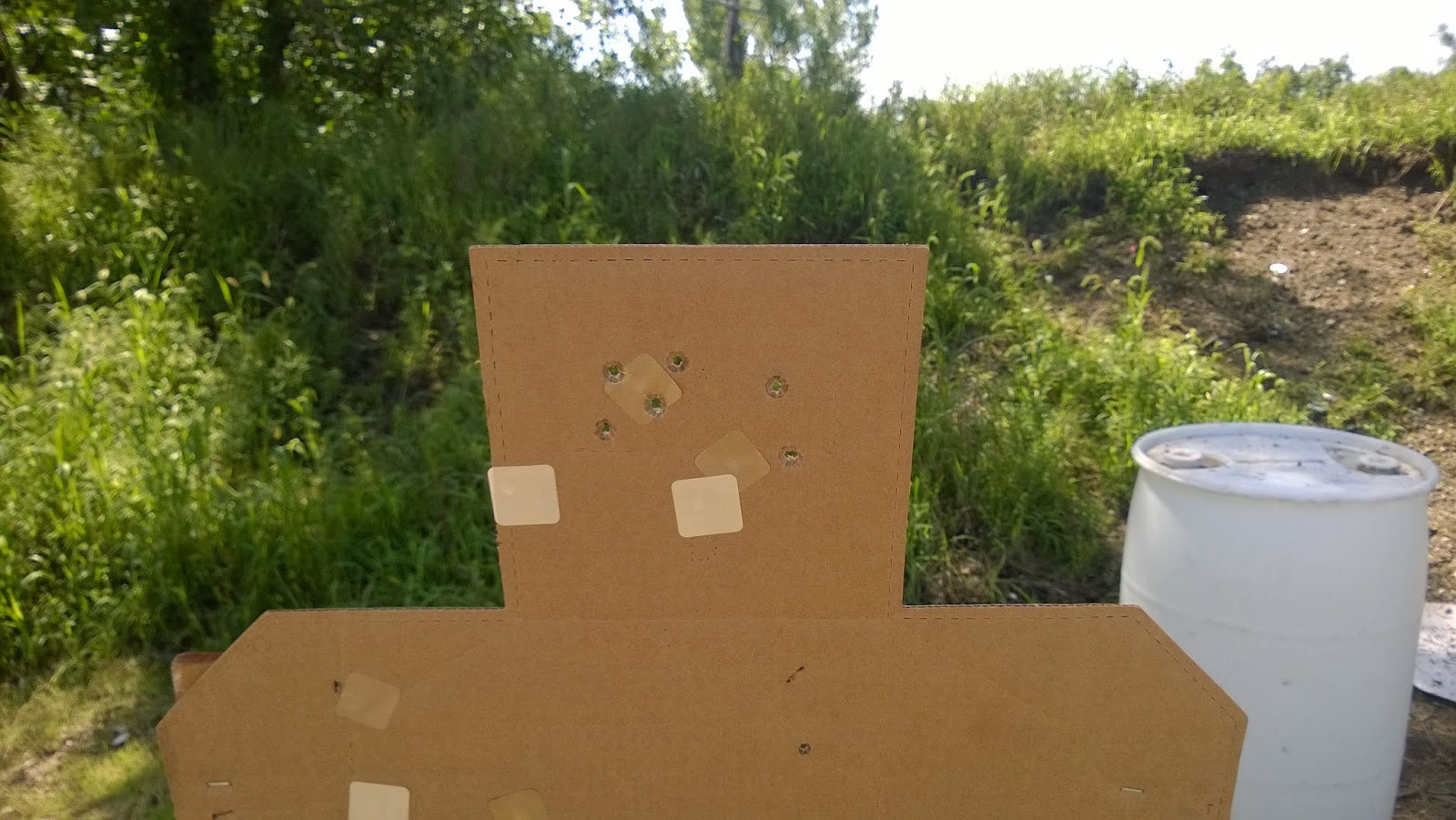 | ||
| Rapid fire from 3 paces |
I added a Talon rubber grip to mine because the factory plastics are slightly slippery, but other than that, the gun is extremely well designed for carry. There are no external controls except the trigger and magazine release. The takedown lever has been reduced to a pin that rotates with the aid of a standard screwdriver or a cartridge rim. There is no slide stop with which to load or reload--racking the slide is your only option. I don't mind that, and the lack of external controls makes the gun quick out of a holster and nice to carry because it won't poke at you when you move about.
Would I recommend the BU9? Yes, but only conditionally. I'd probably get a similarly sized steel-frame Kahr if I had it to do over again just because of the reliability issues and Beretta's laziness in slide design. This isn't a bad gun, but if you don't want the headaches of a picky eater, I'd look to Kahr or Ruger (who now has a striker-fired LC9). I'll update as soon as I find a reliable carry round. Until then, T-zone hard.
Monday, July 28, 2014
Gamer
Having had some limited success with my PX4 Compact, I went "full retard" and bought an M&P 9 Pro to try and improve my USPSA scores and maybe even classify as "A class" right out of the gates. I've had the M&P 9 Pro for about a month now, and what follows is really a series of hard lessons and observations about USPSA, the M&P, and maybe even some personal improvement.
I can't really separate the gun from the competition and observations about my personal skill level, so here we go.

The first day I had the M&P, I went out and test-fired it at 10 yards. I shot about 2" low, but grouped well. Then I went to a range in at a friend's house and struggled to hit anything at 25 yards with any kind of consistency. It boiled down to the factory trigger being just awful. I bought Apex springs and the Apex Hard Sear, and things got better, but I still don't like it, and I'm still not as accurate at distance as I am with the PX4. More on that later.
That said, I've shot two matches with the M&P and my hit factor has climbed significantly. For those of you who don't USPSA/IPSC or IDPA, hit factor is how many points you can score per second. You can shoot all "A"s and lose horribly by going too slowly. Likewise, you can blast away and make all C/D hits in nothing flat and lose horribly. The only way to win is to make good hits quickly.
The M&P is extremely pleasant to shoot. It has perhaps some more muzzle flip than the magic Beretta, but significantly less felt recoil. In fact, the Beretta once aggravated an old tendon injury in my right arm during an extremely fast burst directed at a disappearing target (shooting a popper activated a clamshell mechanism which briefly exposed a target, then covered it with a "no-shoot"). I can shoot absurdly fast with the M&P with no ill effects on my old-man tendons. This means that on very close targets, I can get my split times down significantly vs. the PX4 Compact.
Second, the M&P is very easy to reload. In fact, it almost seems to feed itself. I do a lot of dry practice, and got good with the PX4, but still fumbled once in a while due to the shorter length of the grip and magazine. Also, the M&P's metal bodied magazines drop free, every single time. The magazine height and width is just perfect. I can now reload subconsciously and this shaves whole seconds off my stage times.
All in all, the M&P 9 Pro is a very good "gamer gun". If I could figure out the trigger, I could probably make "A class" this year and try for "Master" next year. Unfortunately, there's a problem with the nut behind the trigger.
The PX4's trigger has a very light, rolling break that just fits with my trigger cadence, and I can shoot very accurately without having to think about my trigger pull. The M&P has a very sharp break in the last 2/3 of the pull (which leads to a weird follow-through), and I swear the pull weight fluctuates wildly, even with the Apex guts. To shoot accurately, I have to concentrate like I'm trying to keep eye contact and hold polite conversation with a topless Kate Upton. I can't do it for very long at all. And thinking conscious and deliberate thoughts while running a stage will make you quite slow.
However, gun mechanics aside, I found I have a serious problem with my on-board targeting computer.
Some years ago, I was young, "Hooah", and tactical. I had earned a spot in US Army Sniper School, having shot Expert long enough and scored highly on several physical fitness tests. I later declined because my wife was leaving for Iraq, and I would be leaving for Afghanistan again about the time she got back. However, before my wife got her mobilization orders, I trained for Sniper like there was no tomorrow. I ran 3-5 miles a day and shot 250rds or more of .22lr through a bolt-action Savage. After that, I would shoot copious amounts through my Ciener conversion 1911. 22LR grew on trees back then, and one task I undertook was teaching myself to point-shoot, or what I thought was point-shooting. I got so I could double tap the chest A-zone on an IPSC silhouette without looking at my sights from out to 15 yards. I got very quick at this, and even had some success competing with this method using my Para LTC. However, this is just reflexive fire. I'm just pointing my arms and ignoring my sights. While this works at short range, it isn't so hot for steel or at distances greater than 10 yards. At the match yesterday (Sunday) I finally realized I wasn't using my sights at all. I started hastily re-programming myself and ended up doing the best I've ever done at this particular USPSA club.
So, tying this up in a nice literary knot, you should start competing with your local USPSA/IPSC or IDPA club. Competition isn't a combat simulation, and I'll be the first to say it. However, shooting against the clock and competing with fellow shootists can only make you better. Additionally, the safety rules make you learn to move quickly and safely with a hot weapon. I often forget that most people weren't in the military, and never trained to do this. Real combat is never static, so learn to shoot and move. Also, you might just learn a little about yourself. I would never have known that I had improperly programmed my targeting system if I hadn't bought the M&P. Be ready and willing to learn and change as you go.
Finally, I'd like to once again sing the praises of the PX4 Compact. If I were once again Sgt. Gunnut, and HAD to take a sidearm, I'd have the PX4 Compact without question. If you're looking to have a "gamer gun" for competition, you're currently spoiled for choice. Springfield, S&W, and Glock all have great options if you're into striker-fired pistols. CZ currently has the market cornered for traditional DA/SA pistols. The P09 may be the bargain of the century. If your wallet is a bit larger, the CZ Shadow is the way to go.
Now get out there and start getting better. I intend to.
I can't really separate the gun from the competition and observations about my personal skill level, so here we go.
The first day I had the M&P, I went out and test-fired it at 10 yards. I shot about 2" low, but grouped well. Then I went to a range in at a friend's house and struggled to hit anything at 25 yards with any kind of consistency. It boiled down to the factory trigger being just awful. I bought Apex springs and the Apex Hard Sear, and things got better, but I still don't like it, and I'm still not as accurate at distance as I am with the PX4. More on that later.
That said, I've shot two matches with the M&P and my hit factor has climbed significantly. For those of you who don't USPSA/IPSC or IDPA, hit factor is how many points you can score per second. You can shoot all "A"s and lose horribly by going too slowly. Likewise, you can blast away and make all C/D hits in nothing flat and lose horribly. The only way to win is to make good hits quickly.
The M&P is extremely pleasant to shoot. It has perhaps some more muzzle flip than the magic Beretta, but significantly less felt recoil. In fact, the Beretta once aggravated an old tendon injury in my right arm during an extremely fast burst directed at a disappearing target (shooting a popper activated a clamshell mechanism which briefly exposed a target, then covered it with a "no-shoot"). I can shoot absurdly fast with the M&P with no ill effects on my old-man tendons. This means that on very close targets, I can get my split times down significantly vs. the PX4 Compact.
 |
| Re: Recoil control- Note brass in air between my head and the gun, also puff of smoke at the muzzle. |
Second, the M&P is very easy to reload. In fact, it almost seems to feed itself. I do a lot of dry practice, and got good with the PX4, but still fumbled once in a while due to the shorter length of the grip and magazine. Also, the M&P's metal bodied magazines drop free, every single time. The magazine height and width is just perfect. I can now reload subconsciously and this shaves whole seconds off my stage times.
All in all, the M&P 9 Pro is a very good "gamer gun". If I could figure out the trigger, I could probably make "A class" this year and try for "Master" next year. Unfortunately, there's a problem with the nut behind the trigger.
The PX4's trigger has a very light, rolling break that just fits with my trigger cadence, and I can shoot very accurately without having to think about my trigger pull. The M&P has a very sharp break in the last 2/3 of the pull (which leads to a weird follow-through), and I swear the pull weight fluctuates wildly, even with the Apex guts. To shoot accurately, I have to concentrate like I'm trying to keep eye contact and hold polite conversation with a topless Kate Upton. I can't do it for very long at all. And thinking conscious and deliberate thoughts while running a stage will make you quite slow.
However, gun mechanics aside, I found I have a serious problem with my on-board targeting computer.
Some years ago, I was young, "Hooah", and tactical. I had earned a spot in US Army Sniper School, having shot Expert long enough and scored highly on several physical fitness tests. I later declined because my wife was leaving for Iraq, and I would be leaving for Afghanistan again about the time she got back. However, before my wife got her mobilization orders, I trained for Sniper like there was no tomorrow. I ran 3-5 miles a day and shot 250rds or more of .22lr through a bolt-action Savage. After that, I would shoot copious amounts through my Ciener conversion 1911. 22LR grew on trees back then, and one task I undertook was teaching myself to point-shoot, or what I thought was point-shooting. I got so I could double tap the chest A-zone on an IPSC silhouette without looking at my sights from out to 15 yards. I got very quick at this, and even had some success competing with this method using my Para LTC. However, this is just reflexive fire. I'm just pointing my arms and ignoring my sights. While this works at short range, it isn't so hot for steel or at distances greater than 10 yards. At the match yesterday (Sunday) I finally realized I wasn't using my sights at all. I started hastily re-programming myself and ended up doing the best I've ever done at this particular USPSA club.
So, tying this up in a nice literary knot, you should start competing with your local USPSA/IPSC or IDPA club. Competition isn't a combat simulation, and I'll be the first to say it. However, shooting against the clock and competing with fellow shootists can only make you better. Additionally, the safety rules make you learn to move quickly and safely with a hot weapon. I often forget that most people weren't in the military, and never trained to do this. Real combat is never static, so learn to shoot and move. Also, you might just learn a little about yourself. I would never have known that I had improperly programmed my targeting system if I hadn't bought the M&P. Be ready and willing to learn and change as you go.
Finally, I'd like to once again sing the praises of the PX4 Compact. If I were once again Sgt. Gunnut, and HAD to take a sidearm, I'd have the PX4 Compact without question. If you're looking to have a "gamer gun" for competition, you're currently spoiled for choice. Springfield, S&W, and Glock all have great options if you're into striker-fired pistols. CZ currently has the market cornered for traditional DA/SA pistols. The P09 may be the bargain of the century. If your wallet is a bit larger, the CZ Shadow is the way to go.
Now get out there and start getting better. I intend to.
Tuesday, June 10, 2014
Beretta PX4 Compact: Go Small Or Go Home
I've had my PX4 for almost a year, and am approaching the 700 round mark. I've carried it concealed all winter long, it sits on my nightstand, and now I'm using it to compete at a local USPSA club. In short, it's really excellent.
First things first, I've had no malfunctions of any kind, and the magazines all drop free easily. I added a Talon rubber grip two months ago, but that's the only modification I've made.
All in all, the PX4 Compact is a very good all-arounder. It is about as big a gun as I can carry without looking like I'm stealing toaster ovens, but it will hide if I dress around it. It's a no-brainer on the nightstand, being nearly service-sized. And it's not too shabby on the USPSA range. James was kind enough to take some tactical cell phone pics of me on a couple of different runs. What jumped out at me is that the PX4's muzzle is on target while brass is still making an exit in both photos. I also noticed I have a lot of black t-shirts, as these photos were taken two weeks apart.
Two things really stand out in this platform: accuracy and recoil control.
The PX4 Compact is as accurate or more so than my custom, tuned-up, high-dollar Para LTC. I've shot it to 100 meters with relative ease. It groups well with whatever ammo I feed it (though 124gr seems to do slightly better than 115 or 147). The Texas Star at my gun club lives in fear of me. The PX4 Compact has eclipsed the great and powerful FN Hi-Power as my best weapon.
I have photographic evidence of the recoil control. Below are two pictures taken two weeks apart. Both show brass in the air, and the muzzle back on target. It feels like a much larger, all-metal gun. I wouldn't think twice about carrying this gun as a duty piece. Or for combat, were I a contractor. On the competition range, I don't feel handicapped by the barrel length or sight radius at all. I score just as many or more points per stage than the competition using 4" and 5" guns, I just did it slower. And that was a software problem, not a hardware one.
 |
| Note brass about ear muff high, muzzle back on target already. |
 |
| Brass between my head and the gun (the spot on the white barrel), muzzle on target. |
Now, I do have some cautions. This gun has a very large grip. Even with the "small" panel installed, this isn't an ideal pistol for Grandma or little sister (or Peter Dinklage). If you have large-ish hands, it will probably fit well. If not, you'll probably struggle to hit the mag release and the safety-decocker. The slide release is nicely oversized, so that won't be a problem.
I added the Talon rubber grips because Beretta's plastics are slightly slippery. I didn't have trouble getting purchase on the gun before, but my Nano was like a wet bar of soap, and Talon gives a good discount if you buy multiple grips. Since adding them, I would recommend this as a necessary upgrade.
Apart from the grips, the PX4 is almost perfect. It's the first pistol I've owned that I have no plans to upgrade or change in any serious way. If you like traditional DA guns, and you liked the 92 but thought it was too bulky or heavy, this is the gun for you. I just wish they made a 5" Competitzione version.
Wednesday, May 21, 2014
Nobody Needs An MRAP
Law-enforcement officials of a certain political persuasion are apt to tell you that "Nobody needs an AR15". Well, bearing in mind numerous law enforcement failures of late, I would turn a similar phrase: "Nobody needs an MRAP."
I'll remind you again that I'm not a cop-hater. I'm all for constitutional and common-sense policing. In the last few years there has been a conspicuous lack of common sense when it comes to SWAT teams in particular. See this CATO institute map showing recent SWAT debacles. Hell, just Google "SWAT raids wrong house" and you'll get way too many hits.
So today, I saw this story from The Daily Mail about a Sheriff in Indiana who needs an MRAP to fight all the veterans returning from war (his words, not mine). The military is offering MRAPs to various law-enforcement departments nationwide at bargain-basement prices. Not wanting to pass up an MRAP for roughly $499,500 off list price, many departments are buying them.
The problem is that SWAT teams are already wreaking havoc with the equipment they have now. Imagine a wrong-door raid where some genius decides to breach the house with his shiny new 60,000lb MRAP because, well, he can. Currently, SWAT teams are getting away with murder (sometimes literally). County attorneys won't prosecute officers for gross misconduct, and Joe Citizen's only recourse is a lawsuit, which most municipalities don't really fear anymore. I don't want to give SWAT teams any new tools with which to terrorize law-abiding citizens.
But not being one to just bitch and moan, I'll propose some SWAT reforms.
1) SWAT members must take a class on constitutional law, and take refreshers yearly.
2) Team members must qualify with their weapons quarterly, if not monthly.
3) Team members must pass a warrant writing class, and demonstrate that they understand how to read a warrant (especially the address of the place to be searched).
4) Every raid has an official AAR with city council members or other civilian oversight present.
5) Three wrong-door raids in any 12-month period results in the team being disbanded and the leadership (sergeant and above) fired. All funds set aside for the team in the future will be paid back to the taxpayers. Officers involved in a wrong-door raid will personally apologize to the victims, and pay for all damages to property. They will also re-train on warrant writing and reading.
I don't want this to spiral out of control to a political blog, so I'll take a break from this stuff for a while. I write this because I care about the image police have in this country. I have friends who are cops. I was a cop. I want them to be safe, and I want you to feel safe around them. Unfortunately, that can't happen until we get a handle on police use of force. I would urge any cops in the audience to push their peers to excel as professionals and seek extra training in use of force and constitutional law.
I'll remind you again that I'm not a cop-hater. I'm all for constitutional and common-sense policing. In the last few years there has been a conspicuous lack of common sense when it comes to SWAT teams in particular. See this CATO institute map showing recent SWAT debacles. Hell, just Google "SWAT raids wrong house" and you'll get way too many hits.
WARNING! GRAPHIC VIDEO. NOT KID-SAFE OR WORK-SAFE!
So today, I saw this story from The Daily Mail about a Sheriff in Indiana who needs an MRAP to fight all the veterans returning from war (his words, not mine). The military is offering MRAPs to various law-enforcement departments nationwide at bargain-basement prices. Not wanting to pass up an MRAP for roughly $499,500 off list price, many departments are buying them.
The problem is that SWAT teams are already wreaking havoc with the equipment they have now. Imagine a wrong-door raid where some genius decides to breach the house with his shiny new 60,000lb MRAP because, well, he can. Currently, SWAT teams are getting away with murder (sometimes literally). County attorneys won't prosecute officers for gross misconduct, and Joe Citizen's only recourse is a lawsuit, which most municipalities don't really fear anymore. I don't want to give SWAT teams any new tools with which to terrorize law-abiding citizens.
But not being one to just bitch and moan, I'll propose some SWAT reforms.
1) SWAT members must take a class on constitutional law, and take refreshers yearly.
2) Team members must qualify with their weapons quarterly, if not monthly.
3) Team members must pass a warrant writing class, and demonstrate that they understand how to read a warrant (especially the address of the place to be searched).
4) Every raid has an official AAR with city council members or other civilian oversight present.
5) Three wrong-door raids in any 12-month period results in the team being disbanded and the leadership (sergeant and above) fired. All funds set aside for the team in the future will be paid back to the taxpayers. Officers involved in a wrong-door raid will personally apologize to the victims, and pay for all damages to property. They will also re-train on warrant writing and reading.
I don't want this to spiral out of control to a political blog, so I'll take a break from this stuff for a while. I write this because I care about the image police have in this country. I have friends who are cops. I was a cop. I want them to be safe, and I want you to feel safe around them. Unfortunately, that can't happen until we get a handle on police use of force. I would urge any cops in the audience to push their peers to excel as professionals and seek extra training in use of force and constitutional law.
Tuesday, May 20, 2014
A Cautionary Tale Redux
While at a private range on Saturday, James (thanks for the camera work and video editing!) and I shot a mock-up of the Iowa Falls shooting I wrote about a while back. Let me lay out the design of the "experiment".
The Iowa AG's report says that five officers fired a total of 68 rounds in 7-8 seconds. Channel 13 WHO says the subject was struck 17 times, leaving 51 misses. The AG and Channel 13 agree that the shots came from no further than 25 feet. From the video, it appears that the officers were already either on target or at the low ready when the firing began (they did not quick-draw and fire, they were more or less ready to fire when Fitz went for his gun).
Obviously we can't precisely re-enact the event itself because (1) I don't have five armed former operational operator friends who can be in the same place at the same time, and (2) the officers were in a circle and firing past eachother, and I'm not going to do that. But we can work with the averages.
On average, each officer fired 14 rounds, and hit four times from a maximum distance of 25 feet. So, what we did was use an M&P 9 loaded with 15 rounds and shot at an IPSC silhouette at a measured distance of 30 feet. We used a shot timer set to "random" to surprise the shooter, and set it to beep again at six seconds, signaling the end of the event. Any rounds not fired at the second beep would be counted as misses. We wore a 33lb ballistic vest to restrict our movement and just generally make life harder. Then we did rifle PT to exhaust our arms and shoulders, which makes shooting a handgun harder as well as raise our heart rates and simulate the stress of a life-and-death situation (if one can do that...). Additionally, whoever was not acting as the "officer" fired a 5.45x39mm AR15 about four feet to the right of the "officer" to attempt to add confusion and maybe impart some distracting muzzle blast.
Without further stalling, this is me talking unscripted on camera:
To cut through my rambling at the end, what it boils down to is that there really isn't an excuse for missing 75% of the time from across-the-room distances. There was time to set up a perimeter and evacuate neighbors, but no one thought to grab their shotgun or AR. If you're expecting trouble, always take the long gun. ALWAYS. The subject's soft-armor vest would not have taken a hit from a 5.56, and likely not a 12ga slug or full spread of buckshot. I would bet that there were so many misses because officers were trying to shoot around the vest. That is a fairly old SOP that should be revisited as police have new tools at their disposal (such as AR15s). Also, without steel or ceramic plates, all that energy from the bullet goes into the wearer, so 68 hits from a .40 S&W (supposing they didn't compromise the vest, which repeated hits sometimes do) would have laid down a ton of hurt.
As an infantryman in Afghanistan, I had to justify every round fired by my soldiers during the AAR. Big Army wanted to know who fired what in which direction, why that type of weapon was used, and anticipated collateral damage (the correct answer was "none" or you were on the naughty list). If we're going to hold soldiers at war to that standard, I think it's fair to hold peace officers to it as well. Personally, I believe the shooting was justified. However, the tactics and marksmanship were abysmal and every officer who was there needs to re-train on small-unit tactics (i.e. DON'T FORM A CIRCULAR FIRING SQUAD!) and all the departments need to seek some marksmanship training from a reputable source. Also, SOPs for dealing with armored assailants needs to be addressed. I'm glad no officers or innocents were hurt, but this could have ended very differently. Training is essential and I hope the departments involved are seeking it.
The Iowa AG's report says that five officers fired a total of 68 rounds in 7-8 seconds. Channel 13 WHO says the subject was struck 17 times, leaving 51 misses. The AG and Channel 13 agree that the shots came from no further than 25 feet. From the video, it appears that the officers were already either on target or at the low ready when the firing began (they did not quick-draw and fire, they were more or less ready to fire when Fitz went for his gun).
Obviously we can't precisely re-enact the event itself because (1) I don't have five armed former operational operator friends who can be in the same place at the same time, and (2) the officers were in a circle and firing past eachother, and I'm not going to do that. But we can work with the averages.
On average, each officer fired 14 rounds, and hit four times from a maximum distance of 25 feet. So, what we did was use an M&P 9 loaded with 15 rounds and shot at an IPSC silhouette at a measured distance of 30 feet. We used a shot timer set to "random" to surprise the shooter, and set it to beep again at six seconds, signaling the end of the event. Any rounds not fired at the second beep would be counted as misses. We wore a 33lb ballistic vest to restrict our movement and just generally make life harder. Then we did rifle PT to exhaust our arms and shoulders, which makes shooting a handgun harder as well as raise our heart rates and simulate the stress of a life-and-death situation (if one can do that...). Additionally, whoever was not acting as the "officer" fired a 5.45x39mm AR15 about four feet to the right of the "officer" to attempt to add confusion and maybe impart some distracting muzzle blast.
Without further stalling, this is me talking unscripted on camera:
To cut through my rambling at the end, what it boils down to is that there really isn't an excuse for missing 75% of the time from across-the-room distances. There was time to set up a perimeter and evacuate neighbors, but no one thought to grab their shotgun or AR. If you're expecting trouble, always take the long gun. ALWAYS. The subject's soft-armor vest would not have taken a hit from a 5.56, and likely not a 12ga slug or full spread of buckshot. I would bet that there were so many misses because officers were trying to shoot around the vest. That is a fairly old SOP that should be revisited as police have new tools at their disposal (such as AR15s). Also, without steel or ceramic plates, all that energy from the bullet goes into the wearer, so 68 hits from a .40 S&W (supposing they didn't compromise the vest, which repeated hits sometimes do) would have laid down a ton of hurt.
As an infantryman in Afghanistan, I had to justify every round fired by my soldiers during the AAR. Big Army wanted to know who fired what in which direction, why that type of weapon was used, and anticipated collateral damage (the correct answer was "none" or you were on the naughty list). If we're going to hold soldiers at war to that standard, I think it's fair to hold peace officers to it as well. Personally, I believe the shooting was justified. However, the tactics and marksmanship were abysmal and every officer who was there needs to re-train on small-unit tactics (i.e. DON'T FORM A CIRCULAR FIRING SQUAD!) and all the departments need to seek some marksmanship training from a reputable source. Also, SOPs for dealing with armored assailants needs to be addressed. I'm glad no officers or innocents were hurt, but this could have ended very differently. Training is essential and I hope the departments involved are seeking it.
Saturday, May 3, 2014
A Cautionary Tale
There was an unfortunate situation in Iowa Falls a couple of weeks ago. A very troubled young man was killed in a standoff with police, but that's not the most troubling part of the story. No, the most troubling thing is that 22 police officers formed a circular firing squad and shot *at best* 25% hits from 8 to 25 feet away. Read the article and watch the video here before continuing so I don't have to write a sketch of the AG's report. Personally, I think the suspect committed suicide by cop, and I don't fault the cops for shooting, as Fitz can be seen with a gun in his hand as he fell to the ground. The shoot was probably justified, but the tactics and accuracy are totally indefensible.
So, we have 22 officers on scene, a four-man takedown team, and one armed and dangerous disturbed person. Sixty-eight (68!) rounds were fired by five officers and the suspect's family say he was struck 17 times. That works out to exactly 25% hits. The officers formed a circle around the suspect and fired at eachother, as can be seen in the video.
So what went wrong?
First, tactics. When I was a cop, I worked with other officers from other departments regularly. But we never trained together, nor trained for situations like this. So when the fecal matter hit the oscillating blades, there is a good chance that there was no chain of command (or likely several independent chains of command, which is worse) nor a plan of action aside from what they could cook up in just a couple of minutes. The four-man takedown team was a good idea, but the lethal-cover officers should have been moved out of the line of fire and instead of a circle, they should have formed an L-shape. Circular firing squads are a bad idea, and EVERYONE there should have seen the problem and made some effort to fix it. They are extremely lucky that no officers were shot.
Second, accuracy. The number of hits in this situation is absolutely sad. I did the math, and it works out to every officer shooting 13 or 14 rounds, and hitting a maximum of FOUR times. From the video, we see that the takedown team behind Fitz was at most 10 feet away, and the other two firing officers were in the middle of the street on the opposite side. This is at most 30 feet away. All officers had their weapons drawn, and the muzzles were probably either on target or at the low ready position. How you can miss 75% of the time from 10 yards is beyond me, but I do have a theory. The suspect was wearing a ballistic vest, so I think the officers were trying for head or groin shots. I don't know the make or model of the vest he wore, but I can't imagine it would have stopped a volley of .40S&W. Even if it did, it was soft armor and he still would have suffered quite a beating from the rounds. I don't know if any officers had long guns, but this would be a good case for cover officers carrying AR15 carbines with green tip. Really, any FMJ round fired from a rifle will shred soft armor. But, you still have to hit your target.
The purpose of this article isn't to beat up the officers (though a light thrashing is in order for missing 51 times from less than 10 yards). I do have suggestions of how to prevent this sort of thing in the future.
1- Planning.
There needs to be an established emergency chain of command. Department X's ranking officer on scene is in charge, period.
Also, the Army's "Five Point Contingency Plan" would be a good outline for making a quick tactical plan. The takedown team could have coordinated with the perimeter cover officers to create a distraction in order to deploy less-lethal measures or just tackle the guy. And, if everything went all to hell, there's a plan for who will shoot in what direction and fall-back positions for the takedown team. All this planning can be done in a minute or two if you've practiced. I used it a couple of times on overwatch missions to move a small DDM team to better recon positions outside our patrol base. Everyone knows what's going on, and what to do in most foreseeable situations. And it's easy.
2- Accuracy.
Practice is the obvious answer, but it goes a little deeper than that. There was time to get 22 officers from four different departments on-scene, so there was time for one or two guys to go get long guns and set a proper perimeter.
Also, the good old fashioned mag dump is an acceptable tactic now and then. It wasn't in this situation though. 51 bullets hit everything except their intended target. Shooting once or twice and then re-assessing the threat is perfectly acceptable, and also easy to do without sacrificing security. Travis Haley's phrase "thinkers before shooters" echoes all over this situation.
Of the seven or eight people who routinely read this, if you are police officers or know any, please encourage them to get the proper training, and think about catastrophic situations like this unfortunate case.
So, we have 22 officers on scene, a four-man takedown team, and one armed and dangerous disturbed person. Sixty-eight (68!) rounds were fired by five officers and the suspect's family say he was struck 17 times. That works out to exactly 25% hits. The officers formed a circle around the suspect and fired at eachother, as can be seen in the video.
So what went wrong?
First, tactics. When I was a cop, I worked with other officers from other departments regularly. But we never trained together, nor trained for situations like this. So when the fecal matter hit the oscillating blades, there is a good chance that there was no chain of command (or likely several independent chains of command, which is worse) nor a plan of action aside from what they could cook up in just a couple of minutes. The four-man takedown team was a good idea, but the lethal-cover officers should have been moved out of the line of fire and instead of a circle, they should have formed an L-shape. Circular firing squads are a bad idea, and EVERYONE there should have seen the problem and made some effort to fix it. They are extremely lucky that no officers were shot.
Second, accuracy. The number of hits in this situation is absolutely sad. I did the math, and it works out to every officer shooting 13 or 14 rounds, and hitting a maximum of FOUR times. From the video, we see that the takedown team behind Fitz was at most 10 feet away, and the other two firing officers were in the middle of the street on the opposite side. This is at most 30 feet away. All officers had their weapons drawn, and the muzzles were probably either on target or at the low ready position. How you can miss 75% of the time from 10 yards is beyond me, but I do have a theory. The suspect was wearing a ballistic vest, so I think the officers were trying for head or groin shots. I don't know the make or model of the vest he wore, but I can't imagine it would have stopped a volley of .40S&W. Even if it did, it was soft armor and he still would have suffered quite a beating from the rounds. I don't know if any officers had long guns, but this would be a good case for cover officers carrying AR15 carbines with green tip. Really, any FMJ round fired from a rifle will shred soft armor. But, you still have to hit your target.
The purpose of this article isn't to beat up the officers (though a light thrashing is in order for missing 51 times from less than 10 yards). I do have suggestions of how to prevent this sort of thing in the future.
1- Planning.
There needs to be an established emergency chain of command. Department X's ranking officer on scene is in charge, period.
Also, the Army's "Five Point Contingency Plan" would be a good outline for making a quick tactical plan. The takedown team could have coordinated with the perimeter cover officers to create a distraction in order to deploy less-lethal measures or just tackle the guy. And, if everything went all to hell, there's a plan for who will shoot in what direction and fall-back positions for the takedown team. All this planning can be done in a minute or two if you've practiced. I used it a couple of times on overwatch missions to move a small DDM team to better recon positions outside our patrol base. Everyone knows what's going on, and what to do in most foreseeable situations. And it's easy.
2- Accuracy.
Practice is the obvious answer, but it goes a little deeper than that. There was time to get 22 officers from four different departments on-scene, so there was time for one or two guys to go get long guns and set a proper perimeter.
Also, the good old fashioned mag dump is an acceptable tactic now and then. It wasn't in this situation though. 51 bullets hit everything except their intended target. Shooting once or twice and then re-assessing the threat is perfectly acceptable, and also easy to do without sacrificing security. Travis Haley's phrase "thinkers before shooters" echoes all over this situation.
Of the seven or eight people who routinely read this, if you are police officers or know any, please encourage them to get the proper training, and think about catastrophic situations like this unfortunate case.
Monday, March 31, 2014
On Training
There is no shortage of tacticool schools out there, which is really unfortunate for those who didn't get the opportunity to experience ten years in the Army and two years in combat. The problem I see most often with these schools is that they're all focused on the wrong thing: combat.
You could kill hours and hours on YouTube or Everydaynodaysoff watching herpy derps "train" people to do ridiculous things like bump-fire at an area target or charge in, guns blazing. In real life, these things will only ensure that you will be criminally charged.
What you should definitely know how to do is hit one to three targets very solidly in as little time as possible, drawing from concealment at three to seven yards. But that doesn't sell people on a $500-$700 class. Gimmicks like no-light shoot houses and cameramen downrange seem to do that.
The biggest thing you should probably know though, is combat medicine. First aid is acceptable, but falls short of real immediate trauma care. Also, you'll find that most off-the-shelf medical kits are really just expensive boxes with band-aids and Neosporin. In real life, medical knowledge will go a lot further than knowing how to clear your house by yourself (which will result in you needing Quick Clot and a tourniquet. Or a bodybag.).
Just the other day at work, one of our HVAC techs fell off some scaffolding and hit his posterior on a steel door frame on the way down. This caused a 5" laceration on his ass, which bled enough to alarm the poor fellow, but was all capillary bleeding from his skin. It was deep enough that I could see quite a lot of ass fat. Using my Army CLS skills, I went to the heavy-duty kit in the job trailer and got shitloads of gauze and an ACE wrap to serve as a protective cover for the gauze packing and wrap. My wrap did well enough that by the time he got to the hospital, his ass had stayed intact enough that they could stitch the wound without any extra cutting to facilitate a clean stitching.
Learn combat medicine (classes do exist--seek Navy corpsmen if at all possible). You may save a friend's ass, or even your own.
You could kill hours and hours on YouTube or Everydaynodaysoff watching herpy derps "train" people to do ridiculous things like bump-fire at an area target or charge in, guns blazing. In real life, these things will only ensure that you will be criminally charged.
What you should definitely know how to do is hit one to three targets very solidly in as little time as possible, drawing from concealment at three to seven yards. But that doesn't sell people on a $500-$700 class. Gimmicks like no-light shoot houses and cameramen downrange seem to do that.
The biggest thing you should probably know though, is combat medicine. First aid is acceptable, but falls short of real immediate trauma care. Also, you'll find that most off-the-shelf medical kits are really just expensive boxes with band-aids and Neosporin. In real life, medical knowledge will go a lot further than knowing how to clear your house by yourself (which will result in you needing Quick Clot and a tourniquet. Or a bodybag.).
Just the other day at work, one of our HVAC techs fell off some scaffolding and hit his posterior on a steel door frame on the way down. This caused a 5" laceration on his ass, which bled enough to alarm the poor fellow, but was all capillary bleeding from his skin. It was deep enough that I could see quite a lot of ass fat. Using my Army CLS skills, I went to the heavy-duty kit in the job trailer and got shitloads of gauze and an ACE wrap to serve as a protective cover for the gauze packing and wrap. My wrap did well enough that by the time he got to the hospital, his ass had stayed intact enough that they could stitch the wound without any extra cutting to facilitate a clean stitching.
Learn combat medicine (classes do exist--seek Navy corpsmen if at all possible). You may save a friend's ass, or even your own.
Sunday, March 23, 2014
Extras, Storage, Organization
Never one to waste space, or buy non-utilitarian gun parts, I've decided to write a short commentary on what should be in your extra space and what merits its own accommodations.
With hollow rifle stocks or pistol grips, I store gun-specific support items. For instance, in my AR pistol's BCM grip, I keep a couple of spare CR2 batteries for my optic. I wrap those in zip-top sandwich bags to prevent them from contacting eachother, and also to keep them from getting wet. Also, a tightly wrapped sandwich bag will prevent any rattling. This is helpful for operators operating operationally, or for hunting purposes.

My 20" AR wears a scope, and that merits carrying a lens pen. Rather than let one float around in my range bag, or a rucksack (if I were still an operational operator), I keep it wrapped tightly in a plastic bag in the pistol grip.

As for the capacious Magpul stock, I keep a reasonable field cleaning kit. I stripped down an issued OTIS cleaning kit. I have the cable, .22 wire brush, .22 patch loop, pull handle, and infamous green toothbrush. If you have room, a small non-aerosol lubricant source would be great. I also throw a few q-tips in there in case the bolt were to need deep cleaning. All of this goes into a zip-top bag for the aforementioned reasons, plus if you have lube in there, you'll want it wrapped up because it will explode and coat everything in CLP. CLP stinks, and if this is your coyote gun, ol' Wile E. Coyote will smell you a mile away.

So what doesn't go in these two spaces?
1. Medical supplies.
I have a blowout kit in my range bag. It's full of leftovers from the Army, but it has the bare essentials: exam gloves, two CAT tourniquets, one medium bandage, one small pack of surgical gauze, one medium QuickClot bandage, and some medical tape. Check your expiration dates, and NEVER use QuickClot for anything but very serious wounds. If you aren't trained in the use of it, don't carry it. Tampons will do nicely, and are FAR cheaper. A blowout kit does not include: ACE bandages, band-aids, Neosporin, or Motrin. That would be a very basic comfort care kit, and sorely insufficient for emergency medical needs.
Also, for the operational operator, if you get shot ( in combat, your med kit is for YOU, not THEM), your buddy will have to take your rifle apart to treat you. This is unhandy if you are still in fighting shape, and wastes time vs. just having your IFAK on your vest.
2. Ammunition.
There is something to the "last mag" theory where you keep your very last bit of ammunition somewhere separate. Inside your rifle's furniture is the wrong place because you can only store loose ammo there, and that is dumb on a bunch of different levels. Instead, keep one magazine in your assault pack, or on the back of your armor. Or if you're just competing in 3-Gun or coyote hunting, don't worry about it at all.
3. Skittles.
Are you Dugan Ashley? No? Lose the skittles.
With hollow rifle stocks or pistol grips, I store gun-specific support items. For instance, in my AR pistol's BCM grip, I keep a couple of spare CR2 batteries for my optic. I wrap those in zip-top sandwich bags to prevent them from contacting eachother, and also to keep them from getting wet. Also, a tightly wrapped sandwich bag will prevent any rattling. This is helpful for operators operating operationally, or for hunting purposes.
My 20" AR wears a scope, and that merits carrying a lens pen. Rather than let one float around in my range bag, or a rucksack (if I were still an operational operator), I keep it wrapped tightly in a plastic bag in the pistol grip.
As for the capacious Magpul stock, I keep a reasonable field cleaning kit. I stripped down an issued OTIS cleaning kit. I have the cable, .22 wire brush, .22 patch loop, pull handle, and infamous green toothbrush. If you have room, a small non-aerosol lubricant source would be great. I also throw a few q-tips in there in case the bolt were to need deep cleaning. All of this goes into a zip-top bag for the aforementioned reasons, plus if you have lube in there, you'll want it wrapped up because it will explode and coat everything in CLP. CLP stinks, and if this is your coyote gun, ol' Wile E. Coyote will smell you a mile away.
So what doesn't go in these two spaces?
1. Medical supplies.
I have a blowout kit in my range bag. It's full of leftovers from the Army, but it has the bare essentials: exam gloves, two CAT tourniquets, one medium bandage, one small pack of surgical gauze, one medium QuickClot bandage, and some medical tape. Check your expiration dates, and NEVER use QuickClot for anything but very serious wounds. If you aren't trained in the use of it, don't carry it. Tampons will do nicely, and are FAR cheaper. A blowout kit does not include: ACE bandages, band-aids, Neosporin, or Motrin. That would be a very basic comfort care kit, and sorely insufficient for emergency medical needs.
Also, for the operational operator, if you get shot ( in combat, your med kit is for YOU, not THEM), your buddy will have to take your rifle apart to treat you. This is unhandy if you are still in fighting shape, and wastes time vs. just having your IFAK on your vest.
2. Ammunition.
There is something to the "last mag" theory where you keep your very last bit of ammunition somewhere separate. Inside your rifle's furniture is the wrong place because you can only store loose ammo there, and that is dumb on a bunch of different levels. Instead, keep one magazine in your assault pack, or on the back of your armor. Or if you're just competing in 3-Gun or coyote hunting, don't worry about it at all.
3. Skittles.
Are you Dugan Ashley? No? Lose the skittles.
Sunday, March 16, 2014
AR and AK Musings.
My FaceTube feed has been full of Army buddies' pics of their brand new ultra-expensive ARs and AKs. I am incredibly suspicious of new manufacturers, especially when their prices are three or four times what a service rifle costs. While I'm not going to name names, one guy in particular paid $2400 for an 18" direct-impingement AR with a fancy paint scheme. For that money, you could spec up your own build and have the mother of all ARs. Or for half of that, you could build a top-shelf service rifle.
I guess I'm writing this as a word of warning. Just because you pay three times the market rate for a rifle doesn't mean you're getting "the best". In fact, if you're hell-bent on spending your life savings, you're a lot better off to go to a reputable smith and have him spec up a rifle for you. Or build a nice service rifle and then get an awesome scope like an ACOG or the US Optics 1.5-6x I've had my eye on for a while.
There are reasons to pay more for a rifle. For instance, BCM's M16 bolt is all machined steel and has a heavy duty coating. It costs twice as much as a "semi auto" bolt with a MIM or cast extractor and gas key. But it is far more durable and because of its greater weight, will help slow the cyclic rate and be more reliable.
Additionally, the Vltor A5 actually slows your cyclic rate and will make your pistol or carbine more reliable and nicer to shoot. If you're stuck on a rifle (like me) the Magpul rifle stock has more storage space, is more comfortable, and is easier to bag down than an A2 stock. They cost more money than their alternatives, but they're worth it.
In short, do some research and make sure you're paying for actual parts and not blue-sky and a fancy paint job. Nice ARs do cost a little more, but you should be getting real, quantifiable performance upgrades for the increased cost.
AKs are another story entirely. To oversimplify, an AK is an AK. Romanian WASRs are of notably terribly quality, with a well-known canted sight problem (among others). They used to be FAR cheaper than the other makes, but now they're all about the same $500, so buy a Yugo or a VZ58. You can spend $1000 on a very pretty Arsenal AK, and I have a hunting buddy who did just that, but his Arsenal is no more accurate, nor any nicer to shoot than any mid-price AK. All that money paid for is a milled receiver, which is very pretty to admire for its flawless machine work. But the tolerances are about the same as any of the cheaper stamped models.
Do your research and don't get suckered by pretty finishes. Build the rifle you want, and putting a pretty finish on will only run you another $200-350 in cerakote. Caveat emptor.
I guess I'm writing this as a word of warning. Just because you pay three times the market rate for a rifle doesn't mean you're getting "the best". In fact, if you're hell-bent on spending your life savings, you're a lot better off to go to a reputable smith and have him spec up a rifle for you. Or build a nice service rifle and then get an awesome scope like an ACOG or the US Optics 1.5-6x I've had my eye on for a while.
There are reasons to pay more for a rifle. For instance, BCM's M16 bolt is all machined steel and has a heavy duty coating. It costs twice as much as a "semi auto" bolt with a MIM or cast extractor and gas key. But it is far more durable and because of its greater weight, will help slow the cyclic rate and be more reliable.
Additionally, the Vltor A5 actually slows your cyclic rate and will make your pistol or carbine more reliable and nicer to shoot. If you're stuck on a rifle (like me) the Magpul rifle stock has more storage space, is more comfortable, and is easier to bag down than an A2 stock. They cost more money than their alternatives, but they're worth it.
In short, do some research and make sure you're paying for actual parts and not blue-sky and a fancy paint job. Nice ARs do cost a little more, but you should be getting real, quantifiable performance upgrades for the increased cost.
AKs are another story entirely. To oversimplify, an AK is an AK. Romanian WASRs are of notably terribly quality, with a well-known canted sight problem (among others). They used to be FAR cheaper than the other makes, but now they're all about the same $500, so buy a Yugo or a VZ58. You can spend $1000 on a very pretty Arsenal AK, and I have a hunting buddy who did just that, but his Arsenal is no more accurate, nor any nicer to shoot than any mid-price AK. All that money paid for is a milled receiver, which is very pretty to admire for its flawless machine work. But the tolerances are about the same as any of the cheaper stamped models.
Do your research and don't get suckered by pretty finishes. Build the rifle you want, and putting a pretty finish on will only run you another $200-350 in cerakote. Caveat emptor.
Subscribe to:
Posts (Atom)