Saturday, July 20, 2013

Want In One Hand...


I put it to you that every red-blooded American man should own a 30-30 levergun. Growing up in Missouri, everyone who hunted either had a Marlin 30-30 or a Remington 30-06, so I've spent a lot of time with both, but never owned either.

I prefer the 30-30 for my needs, though the '06 is the better all-arounder. What my heart lusts after is the Marlin "Spike Horn". Behold:


 This little spud holds five rounds, and is less than 34" long, which is just shorter than an M4 with the stock fully extended, and weighs just over 6lbs, which is also comparable to a naked M4. 

Now let me explain why I like this caliber and platform, before you insist I start taking my brain pills again.

The 30-30 Winchester (previously the 30 WCF)  was the first sporting round developed for use with smokeless powder, and dates back to 1895. Load data is plentiful, and you can even load lead bullets for shooting very small game, or just plinking without breaking the bank. On the other end of the spectrum, there are a lot of great soft point bullets out there capable of delivering ~2000 ft/lbs--and they're fairly inexpensive. If you reload (and you should), this is a very capable intermediate rifle that is inexpensive to shoot. Also, the 30-30 is proven medicine for deer and antelope. If you hunt the rolling hills of southern Iowa, or brushy woods of north central Missouri, a compact 30-30 is about as good as it gets. While I'm at it, the 30-30 is very light-recoiling, and those lead bullet loads would be about ideal for taking the kiddos deer hunting.

Yes, the 30-30 is not particularly good at long distance shooting. I'll admit I wouldn't take a shot much past 200 yards unless I had spent a lot of time practicing at longer distances. And used a scope. Long shots are hard to come by in my neck of the woods anyway.

I'm a tactical hipster. I'm sick of black guns with tons of bells and whistles. I want a rifle with NO accessories. You pick up the rifle and put bullets in and go. The only modification I would make to the Spike Horn is an improved set of sights, switching from the "buckhorn" style to a receiver-mounted peep sight. I could keep it in a very small soft case with a box or two of cartridges and be totally set. 

Lastly, you can get 30-30 ammo (current crisis aside...) just about anywhere in North America. So if I don't feel like reloading, I can go get a modestly priced box of hunting ammunition at Wal Mart and continue on my merry way. 

Stay tuned for a quick look at my Model 39.


Thursday, June 6, 2013

Finding Your Center (Of The Target)

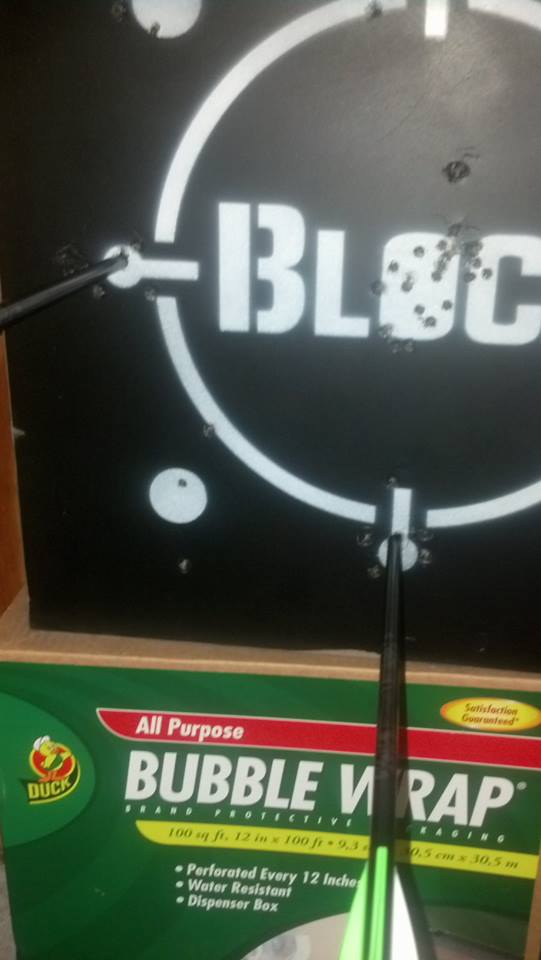
 I got my QAD rest installed today, but did not get the Hunter. Instead, I got the UltraRest LD, which is the mid-range model, yet still costs over $100. But it does seem to be worth it. Results below:


What seems to help the most though, isn't the tech upgrades, but watching interviews with Fred Bear on YouTube. Fred mentioned in one of his last interviews that to hit his target he had to "concentrate from the top of his head to the tip of his toes on the very small spot I want to hit." So I tried that tonight. I went into my garage/man cave, cranked up the Rolling Stones channel on Pandora, and downed a Pabst Blue Ribbon tall boy and relaxed. I picked three of my new XX75 arrows and tucked them into my wood pile at the 10 yard line, and began focusing and relaxing more than I have in a long time. I found that listening to music helped me tune out my surroundings and focus on the target and sight alignment more. The more I liked the song, the better I tended to do. Tomorrow I will shut the music off for a while and see how things go.


As good as my shots were at 10 yards, Fred Bear could do that at 30 yards. In his eighties. With a 45lb recurve.  But Fred was very humble, and seemed very peaceful and clear-minded. I think those qualities will improve your archery skills more than any newfangled rest, seven pin sight, or hypetanium arrow components. If you can find your center, you stand a better chance of finding the center of your target.


Friday, May 31, 2013

Give It A Rest

So begins my first archery gear review. Today's subject is rests and arrows, and what I've learned about both in the last 24 hours.

Carbon arrows are all the rage today. They are very durable, and supposedly will not warp after hitting a solid target. They are very light, and very strong. They also can have catastrophic failures if you do not carefully inspect and flex your arrows EVERY time you shoot. And because they might explode and maim me, I purchased some Easton XX75 "Gamegetter" arrows after work today.

The aluminium Gamegetters were $29 for six arrows, or roughly half what my Gold Tip Velocity arrows cost. I also got a rebate for $5 off, so they were very cheap indeed. The XX75 has been the hunting arrow of choice for about two decades now, and will probably still be popular until someone makes a carbon arrow that won't explode into your forearm. It is old technology, but it works, and it is very cost-effective.

While I would never tell someone not to use carbon arrows, I am not inclined to use them at this time. And you should always inspect your arrows, no matter what spine thickness or material you shoot. Aluminium shows folds or nicks where metal fatigue is setting in--and NEVER shoot for group. Shooting groups is a great way to damage your arrows. Get a target face with multiple bullseyes and shoot one arrow at each. The center is the center, no matter what.

So that said, it's anecdote time.

I got home tonight and went in the garage to see how the new arrows get along with my bow. I shot about 25 times (that's four or five trips through my rest) and on my final shot, I saw a vane tear off, and the arrow went very sideways into my target block, though it impacted very near where I was aiming. This is the biggest downfall of the "whisker biscuit" arrow rest. They WILL tear off vanes and feathers. Most package bows come with this rest because it is cheap and effective. If you shoot 2" vanes, you probably won't have too many issues. And the whisker biscuit is very quiet and sturdy.

It will, however, amplify any mistakes you make when firing because the arrow is in contact with the bow through the entire travel of the string. It will also rob you of about 15-20fps of precious velocity. And they wear out after a while and require combing out (the whiskers eventually get twisted and matted) and eventually replaced.


The most popular replacement is a drop-away rest. This type of rest acts like a free-floating barrel on a rifle. The rest drops away soon after the arrow begins forward movement, and therefore cannot transfer motion to the arrow. Most models of drop-away rests are captive-arrow designs, so though they don't hold on as snugly as the whisker biscuit, they do prevent the arrow from falling out. I'm looking at a QAD Hunter as a replacement for my whisker biscuit.

I will probably get my new rest next weekend, so look for another review then. I'm also in the market for some small-game tips, so maybe I'll splurge and you'll get a review double-header. Until then, inspect your arrows, and respect your fletchings.

Monday, May 27, 2013

Ready For Deer Season (Four Months Too Early)

I spent the best $137 of my life on Saturday. I bought a B20 "Block" target at Sportsman's Warehouse, and my father-in-law bought a "Black Hole" block-style target. We then spent all weekend shooting in our garages. I learned a lot.

First, I bought a four-pack of Apex Doubledown silencers along with my block, and they work great. Since they're essentially a Matthews Monkeytail, I used their installation instructions (useful for placing them in the most effective locations). They seem to work very well. My bow is now essentially silent--and it was very quiet before.

Second, I've gotten pretty good with my Bear Encounter. I can pick off the 1" circles at ten yards all day long. I need to get to Archery Field & Sports and try the 20 and 30 yard lines some time. In any case, I want to get some small game tips and some Grim Reaper mechanical broadheads and hunt some coyotes and rabbits this fall, in addition to my first deer hunt since I was a kid.
Rubber squirrel says I'm ready for deer season.

Third, I spent some time with my father-in-law's Fred Bear Grizzly 45lb recurve, and it is HARD to shoot well, but very fun. Instinctive shooting, as described by Fred Bear himself, is a "you got it or you don't" skill. You can work hard and get better, but at the end of the day you're either an instinctive shooter, or you're not. I'm probably not.

Lastly, Fred Bear was a badass. He was either very brave, or quite insane. Here's a video of the legendary Fred Bear on a polar bear hunt. Skip to 6:15 to see how awesome he was at target shooting and 10:39 to see some awesome bear-shooting.

Saturday, April 27, 2013

Still Chasing The Arrow

I was able to sneak away to Archery Field & Sports this afternoon and spent about an hour quite happily flinging arrows at ranges from 10 to 30 yards. Yes, that's right: I took a brave pill and shot from 30 yards today. I've been replaying the man's advice from last week, and I've since bought a Limb Saver stablilizer and a 550 cord wrist sling. Applying said advice, right away all my left and right errors were gone. Typical 10 yard target below:


After shooting at 10 yards for a few minutes, I was warmed up and went to the 20 yard line. Somehow, I forgot to take pictures of some 20 yard groups, but suffice it to say I was consistently hitting right of center and making a group about the size of the white area of the target. Since I left my allen wrenches at home, I didn't get to adjust my sight housing to bring the group back onto the bullseye. This turned out to be quite good fortune.

I was all alone on the range, and being free from judgemental eyes, I set up a block at 30 yards. I shot three arrows just to make sure I was in the ballpark. Mediocre results below:


I took a minute to relax and clear my head , then stepped up and shot this group:


Supposing that to be beginner's luck, I dropped back and let six more arrows go:

So, I have a few observations to make. First, I fail to see how short bows are "harder to shoot" at longer distances. Second, my lowest pin in my sight is dead on at 30 yards, which means had I adjusted my sight at 10 and 20 yards, I would have been hitting left at 30 yards. My rudimentary sight isn't windage adjustable at the pin--only at the housing, so I can't move the pins independently. I'll have to think my way around this to get my point of aim and point of impact back together. 

Also, I learned that archery is hard, and that a bow is a lot like an AR15 when it comes to accessories. I'm off to search the interwebs for string and limb silencers. That's all for now.

Sunday, April 21, 2013

Choosing A Bow: An Aside

I know almost nothing about archery, so don't expect any shooting tips, equipment reviews, or heavy-handed opinions until I know what the hell I'm doing. That said, I do know a couple of things worth passing along.

First, cams make a difference. The cam is what gives a compound bow its power. The more aggressive--that is, out of round--a cam is, the stiffer the draw will be. Rounder cams make drawing your bow smoother. When choosing a bow, I had narrowed my choices to a PSE Stinger 3G, Martin Prowler Pro, and Bear Encounter. Sportsman's Warehouse only had the PSE and Bear in stock, so I shot them on their little 10yd test-fire range. You HAVE to test-fire a bow before you buy. If a bow doesn't feel right, you won't enjoy shooting as much, and probably won't develop your skills as much as you should.


I made a decent grouping with the PSE, but the draw was VERY stiff and jerky to me. The release was also rather sharp, and though I grouped well, I knew it wasn't the bow for me. Then I shot the Bear. Though the Bear was set at least 5lbs heavier than the PSE, it was much easier to draw, much smoother to shoot, and very quiet. It "spoke" to me. About an hour later, I had it tuned and a set of 6 arrows cut down for me.

Bows also come in many different sizes. They are measured in bow mass (the weight of the bow) and axle-to-axle length. The shortest adult bow you'll see is about 30.5" axle-to-axle, which happens to be the length of my Bear (as well as the Martin Prowler). Length matters depending on what you plan to do with your bow. Tree stand hunters and those hunting in dense brush usually want a shorter bow to avoid snagging on their surroundings. Longer bows are generally more forgiving and offer better long range accuracy than their shorter counterparts. That long range edge primarily comes from being a little easier to shoot, since both are shooting a comparable projectile at a comparable speed over a comparable draw stroke. I like my short bow, but I can attest that it is HARD to shoot at 20yds. Maybe next week I'll take a brave pill and try the 30yd line.

Finally, peak draw weight isn't all its cracked up to be. There are a lot of people (all of whom are male) who crank their bow all the way up, and then shoot like shit, but still brag that they shoot 70lbs or 80lbs. Deer were killed for millenia with self-bows pulling about 25lbs and firing sharpened sticks. Any modern bow at 50lbs is way more than enough to reliably and ethically down medium game. My bow is set at 60lbs because it is very smooth and I don't get tired shooting at that weight. Accuracy is more important than squeezing an extra five or ten feet per second out of your bow.

That's all I know today. Maybe I'll learn more next week. Also, you should take up archery.

Chasing The Arrow


I bought a compound bow yesterday. I'm resorting to archery to satisfy my shooting fix. Today, I spent about three hours at Archery Field & Sports finding out just how little I know about archery.

Just getting started can be dizzying. There are about six hundred million different kinds of bows made by a dozen or so major manufacturers. What I have been told by two bow shop pros is this: to get a good bow, you'll need to spend $400-$500. The bows in that price range are just as fast and forgiving (for the most part) as their $1000+ brethren. Second, brand loyalty is fierce among archers, but the bow your buddy shoots might not feel good to you. Go in with an open mind and buy the bow that "speaks" to you. You shoot a bow almost 100% by how it feels, and if it doesn't feel good, you won't like it and you probably won't hit much. Your bow's draw length and poundage has to be set up specifically for you, which is called "tuning". This is an elaborate process, but a good pro shop guy (or gal) will walk you through it and it won't be scary or expensive. Most places set up your bow for free if you buy from them.

Then you'll need a mechanical release. Almost nobody shoots by hand anymore, and for good reason. A mechanical release lets the string go much more cleanly than most mortals can. One thing that seasoned archers all agree on is DO NOT cheap out on your release. You'll be looking at $60-120 for a good release. Cheap releases have sharp corners that chew up the "D-loop" that connects the release to the bowstring. Also, they usually have crap triggers.

Arrows come in 1.2 bazillion different lengths, sectional densities, and styles. Have a pro help you until you can make sense of arrow-selection charts. "Cheap" arrows for a reasonably stout compound bow are about $45 per 6 arrows. Then the pro shop guy has to cut them down to the proper length for your bow.


Then you'll need tips, but at first you should probably get some field points or target points. They're cheap, and will at least get you shooting. Broadheads come in 3.4 quadrillion styles, weights, and types. They are expensive and you should do your research before you drop any money.


So once you have your gear, you have to zero, just as you would with a firearm. The process is called "chasing the arrow". You shoot for group and then move the sight housing to the point of impact. This is probably the only simple part of archery. The pins within the sight housing are usually pretty damn close to calibrated for whatever distance the manufacturer says they are. My Bear Encounter package bow came with a simple 3-pin sight, and it is calibrated at 10, 20, and 30 yards. I've shot at 10 and 20 yards and it is pretty damn close once I zeroed.

So now lets talk shooting. I went to the range late in the afternoon and started off in the 10yd stall apart from the 10-40yd range. Once satisfied that I was zeroed, I walked over to the "big boy" line and lined up for my first 20yd shot in about 18 years (I learned archery in 4-H when I was about 10 years old). I put two arrows into the white area very near the bullseye. I got excited and shanked three in a row into oblivion. I heard an unsettling delay between release and whack. Upon closer inspection I saw three arrows in the wall at the back of the range, about 12ft up from the floor. My stomach sank and I sheepishly reported to the lady at the front desk that I made a boo boo. I got a step ladder and once I got up there, I realized they were Easton arrows--not mine. A rush of relief washed over me. I looked left and right and found three Gold Tip carbon arrows (mine) stuck in the 10-point buck 3D target at the 40yd line. I apologized for the ordeal and went back to the 10yd line for some introspection and re-training.


Then an older gentleman who was shooting a 3" bullseye at 40yds came over and fixed me. He introduced himself and mentioned that he had been the national champion compound bow shooter in 2007. So I listened intently as the guru told me I was doing basically everything wrong. I followed his advice and my groups immediately shrank, and I stopped throwing arrows left. Trusting in Yoda's advice, I went back to the 20yd side and proceeded to shoot a six arrow group of about 8", nicely centered. I recovered my arrows and tried again. This time it was a 6" group and a couple of arrows were touching. My last group of the day was all in the heart of my deer vitals target. I profusely thanked the man and left to contemplate my inadequacy and write this article.