I know I promised a 3-gun gear and guns article, but I think what most people (myself included) need more is to fix themselves.
I've shed more bad habits just this year than I even knew I had. Competition is a really great way to gage your skills and show you where your weak spots are. Had I not joined USPSA and competed regularly, I would not know I had a faulty targeting program, my reloads were too slow, and I didn't know the first thing about prioritizing targets and making a stage plan (which I now think would help prioritize targets in real life combat). I have a lot of stuff to work on during the off season (Iowa is cold, and my days of being cold, tired, and hungry are long past). People who get testy at the suggestion of competition are probably afraid of finding out just how incomplete their skill sets are. So what follows is a short list of stuff I'm bad at, and quick ways to make up a second here and there.
Your posture makes a difference. The "tactical turtle" is not a great choice if you take it too far. I have been working on keeping my head up since I saw a Jerry Miculek video where he explicitly says not to do the turtle. I'll be darned if my scores haven't climbed wildly since then. I still reflexively raise my shoulders a little, but I'm no longer tucking my jaw down like I did only a month or two ago. Why is this a big deal? Imagine hanging a picture on your wall. Do you tuck your head down and pull in your jaw to eyeball it level? No. You hold your head up squarely over your shoulders and look straight at it. The same is true of your sights. If your head is tucked in and down, you aren't looking straight and level at your sights. It may not make a difference at seven yards, but from 25 and 50 it will make a world of difference. Here's a video of me not turtling at all:
Now me turtling slightly, but head still up-ish:
Drawing can shave time off your score too. Time to first shot is a big deal, so I practice drawing and dry-firing a lot. I know it's a pain, but put your holster on, grab your handgun and a snapcap and go to town. Equally, you could do this with your rifle or shotgun and a snap cap. I do that once in a while, but not super often. It's free and it's easy.
Again, put your gear on and grab your EMPTY magazines and put a snap cap in there (NOT LIVE AMMO, DAMMIT) and practice your reloads. From empty (emergency reload), on the move, topping off, etc. USPSA and 3GN allow you to top the gun off and drop partial mags on the ground. IDPA does not. If you're practicing for your specific discipline, make sure you're adhering to the rules. Here's a reasonably quick reload:
(Hit factor 9.725, thank you)
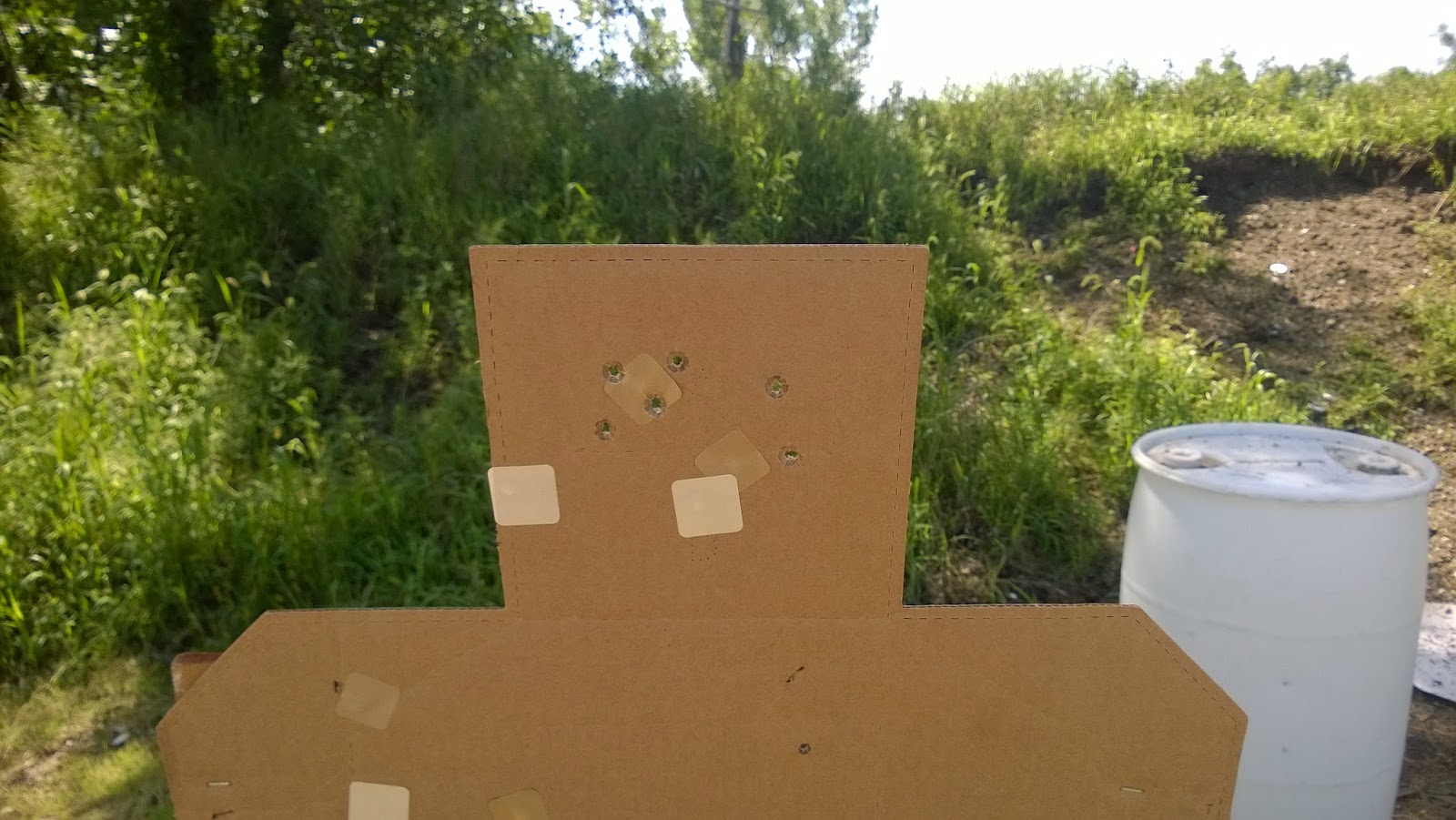
Most of the 3-gun matches in my neck of the woods are on fairly short ranges. Typically less than 100 yards. So what would help a lot is to be able to make good offhand hits from say, 50-100 yards. One really good way to get good offhand is to buy an air rifle and set up a 10 meter range and shoot at absurdly small targets. I set up such a range in my basement and shoot at printer paper with a ~6mm target (2MOA at 10 meters) using an old GAMO piston-powered rifle and a really bad 4x scope. I got my 6mm dot in two shots the other night:
As for the shotgun, well get snap caps and put your belt on and practice your reload. Practice until you get blisters and your fingernails bleed. Then practice some more. Dry your tears and practice more after that. Then get your stuff back out and practice your reloads some more. If you have trouble making your hits, well, I suppose busting some clays would help. Otherwise, it's the reload that will move your name up the list. Unfortunately, the only remedy is practice.
And that's really the one thing you should take away from this whole piece. Just practice. Dry practice is worth way more than you think, and it's cheap if not free. Shut your X-Station360 or PlayBox4 off and pick up your gear. Just 20-30 minutes a day does wonders.
Oh yeah, and all the stuff you need to practice will pay off in real combat also.
Tuesday, November 11, 2014
Wednesday, October 29, 2014
#Winning
I won another local, non-sanctioned 3-gun match over the weekend, and I think I have some more observations that will help newer shootists.
Diving right in, my performance was not all that great, and the only reason I won was that all four stages could use the AR15. My AR15/M-16/M-4 skills by far eclipse any of my other shooting skill sets. Having the opportunity to rip through the cardboard targets with my frankengun AR let me get ahead right off the bat. The AR is my best weapon skill set, and I love ARs. So here's some video I'll pick apart later:
Time: 48.14 seconds clean. First, I failed to press-check my rifle and when the buzzer went off, I got a "click" instead of a "bang". Tap, rack, bang, and I was off. Four of the cardboard had only heads, and despite that, I kept the muzzle moving and my 20 yard double taps were the same speed as those at 7 yards. Did I mention that I really love ARs? So then I planned to use the shotgun to clean up the mini-popper array, then the star and finish with the M&P. What actually happened was that I got too wrapped up in trying to cycle the shotgun as fast as possible and created a false flinch (not a flinch, but same effect). I ran the shotgun dry without realizing it and cost myself an extra two seconds. I had some inexcusable misses with the pistol (although I think the draw was pretty good). When I slowed down slightly and used my sights, the steel dropped. Not a bad run (2nd overall) despite making almost every mistake I could without getting DQ'd.
Time: 50.98 seconds clean. The AR worked its magic again. The targets I start on are 50 yards out, and all had various "hard cover" areas forcing careful aiming to catch the chest A zone. The two close targets were on the near side of 20 yards, and again, I ripped them up just as fast as I can from half the distance. Did I mention I love ARs? I chose not to use the shotgun (I'll get to that later) because my pistol skills are an order of magnitude better than my shotgun skills. I hit the steel, but only when I slowed down and watched my sights. I would drop a few in a row and get excited and try to go faster and miss. I also threw in a reload I didn't need after the four cardboard standing near the berm. Despite some relatively minor mistakes, I won that stage by ten seconds (over a USPSA Master, I might add because I'm a shameless egotist).
Time: 51.58 seconds clean. My fixed 3x Nikon P-223 doesn't slow me down up close, and it makes things way easier beyond 50 yards. There were six rifle steel: one 4" circle swinger target, and a rack of five 4" plates. I missed one plate but hit the ballistic shield on the next shot, and got two plates. The shotgun was a mess. I forgot to count shots, fumbled some rounds, and still somehow won the stage (oh yeah, my AR carried it again). I can empty a shotgun pretty fast, but I can't reload one to save my life.
No video exists of stage four, thank the baby Jesus. I was a train wreck. I had a miss on the 40yd rifle paper targets (my only penalty of the match), worked the shotgun too slow, and pumped about 8 rounds at an 8 yard plate that I just couldn't hit. I was sixth overall with a time of 57.59 plus 2.5 seconds for a paper miss over 40 yards.
So what? Well first, my first stage reinforced my belief that quality practice can save you from your mistakes. I shook off those mistakes like Taylor Swift. Second, knowing your strengths and weaknesses will improve your 3-gun performance. Not good at the shotgun? Skip it. Third, practice your shotgun skills. Being good at shooting and reloading a shotgun sounds easy, but it isn't. Especially a pump action. Practice your ass off and you'll run away from the pack. Unless the stages are AR heavy and some a-hole with a tuned up frankengun shows up. Stay tuned for a follow-up focusing on guns and gear.
Friday, September 19, 2014
Practice, Failure, Improvement
Any discussion of competition would be incomplete without some discussion of practice. Of course, being poor, most of my practice consists of putting on my pistol belt and doing 15-30 minutes of dry practice on nights when I have time. Every couple of weekends though, I can sneak off to the range for a few hours, and that's what I'll focus on today.
I completed (and won) my first 3-gun event on September 13. I had never really practiced any sort of tactical shooting with my shotgun. The above video was a practice stage that James put together so I could get some practice with my scattergun. You can see that things sort of fell apart during the reload. James, master of the scattergun, diagnosed my technique and largely fixed it. I went home and practiced doing it the right way.
This video is Stage 4 at the Eddyville 3-gun match. I made a ton of mistakes, but made good hits, and best of all, my shotgun reload was nice and smooth.
Good training doesn't have to be expensive or elaborate. All you need to get tier-0 operational operator training is: 1) a shot timer, 2) a friend who is better than you , 3) a range, 4) a willingness to learn and change the way you operationally operate.
Don't get discouraged if you fail at a drill, fumble a reload, or leave some steel up during practice. That's the point of practice. If you aren't making any mistakes, you're either Jerry Miculek, or you aren't pushing your failure point. See how fast you can go, make mistakes, shake it off, and complete the stage. Learning to roll with mistakes will also give you a competitive edge.
Doing just a little live fire and a lot of dry fire will go a long way toward pushing your name up the list at your competition of choice. It will also increase your chances of winning an actual shooting match.
Thursday, September 18, 2014
On Competition
Responsible gun owners should seek to improve their skills and stay familiar with the weapons they may use to protect themselves and their families, hunt game, or just poke holes in paper. The best and most cost-effective way to do this is through competition.
Getting involved with your local IDPA or IPSC/USPSA is a really cheap way to get good training. If you can take some constructive criticism, having better shooters diagnose you and help you find speed and/or accuracy is probably the fastest way there is to improve your skills. All it costs is entry fee, typically $10-$20, and 100-150 rounds of ammunition per match.
There are some loud and persistent voices on the interwebs that insist competition is not useful for combat or self defense because "it's a game". I hold that these voices belong to morons.
Yes, competition is a game. There are set rules for your gun, gear, ammo, etc. And yes, you get to see the bad guys before the shooting starts. However, competition hones every skill necessary for you to win a real shooting match. In every stage you will: perform an administrative load, react to contact (on the buzzer), draw, fire accurate controlled pairs, perform reload or emergency reload while moving, engage targets while moving, use visual strategies to group targets by priority, and finally, administratively clear your weapon. Every single thing I listed is important in combat. Learning to do all of these things quickly and efficiently can only help your chances in real combat. Anyone who says that competing isn't good training is wrong.
Your local IDPA/USPSA club is probably also a really great place to get some sage advice from better shooters. The guys at my club are more than willing to critique me when I ask. Sometimes I grab a nugget of wisdom just from chatting while taping up targets or setting up stages. And it's free. I've improved more as a shooter over the last six months than I did during my whole ten years in the infantry, and it's all down to the free advice and training I got at my USPSA club. Maybe I'll look up some of my old scores, but off the top of my head, I'd say I'm averaging 8-10 seconds faster per stage than I was back in April. That's a BIG improvement.
"But it isn't combat training!" shout the voices of internet commandos. Correct. I've been through a good bit of US Army combat training, and very little of it required me to shoot and move, or reload while moving (or at all!). I was never allowed to plan my own assault on the objective, nor make any tactical decisions, period. There were a series of good ranges at Fort Irwin (NTC), an excellent shoot house at Bagram Airfield, and a quite fun impromptu range at Camp Ripley. Apart from that, most of my "combat training" was hand-holding static ranges where I stood in one spot and did exactly what the range safeties said. I have a feeling that if the Army shifted its training to a USPSA or 3 Gun Nation format, our troops would be significantly more effective.
Indeed, it's a game. But it's a game that will make you better at every sub-task that defensive shooting requires. The most effective way to make you a better shooter is to compete. Soak up all the knowledge (not tacticool BS) you can, go in willing to change and grow, be willing to take some criticism, and push your failure point. Be the best shootist you can be. Go compete.
Sunday, August 24, 2014
Let's Get Small: Beretta BU9 Nano
I purchased a Beretta BU9 Nano back in April to replace my ailing P64 as an everyday carry gun. It has taken me some time to do the review because I just now got around 400 rounds through it, and I wanted to carry it a while before I passed judgement. Well, things are mostly good, but not without substantial worries and poor decisions on Beretta's part.
The first day I had the BU9, I put 150 rounds down it. Fifty were Winchester Ranger RA9T 147gr JHP, the other 100 were Federal 115gr FMJ. I had three jams with the Federal at random intervals, and today, after not barfing for over 200 rounds, it choked on a RA9T, but this exact malfunction is the only kind I've seen from it. See below:
Back in June, James and I disassembled the BU9 to see what was going on after it puked on the range. What we found is that the slide appears to have been machined for .40 S&W, and the 9mm case has very little contact with the extractor during recoil. I suspect that Beretta intended to do two versions, one 9x19 and the other .40 S&W, but they never did the .40, and never machined the slides for 9x19, since on paper it should still work. And 90% of the time, it does. As I put more rounds down it, it has become more reliable, and has been flawless with Freedom Munitions 124gr FMJ, so I'm going to stop carrying the RA9Ts and find carry ammo that is as close as possible to the Freedom Munitions load. This thing is very picky about ammo, and that's really not a good thing in a carry piece.
Accuracy, however, is pretty good. And it's pretty decent to shoot fast at defense distances. Here's a couple of IPSC silhouettes I shot after the match today:
![]() |
| Rapid fire from 7 paces |
![]() | ||
| Rapid fire from 3 paces |
I added a Talon rubber grip to mine because the factory plastics are slightly slippery, but other than that, the gun is extremely well designed for carry. There are no external controls except the trigger and magazine release. The takedown lever has been reduced to a pin that rotates with the aid of a standard screwdriver or a cartridge rim. There is no slide stop with which to load or reload--racking the slide is your only option. I don't mind that, and the lack of external controls makes the gun quick out of a holster and nice to carry because it won't poke at you when you move about.
Would I recommend the BU9? Yes, but only conditionally. I'd probably get a similarly sized steel-frame Kahr if I had it to do over again just because of the reliability issues and Beretta's laziness in slide design. This isn't a bad gun, but if you don't want the headaches of a picky eater, I'd look to Kahr or Ruger (who now has a striker-fired LC9). I'll update as soon as I find a reliable carry round. Until then, T-zone hard.
Monday, July 28, 2014
Gamer
Having had some limited success with my PX4 Compact, I went "full retard" and bought an M&P 9 Pro to try and improve my USPSA scores and maybe even classify as "A class" right out of the gates. I've had the M&P 9 Pro for about a month now, and what follows is really a series of hard lessons and observations about USPSA, the M&P, and maybe even some personal improvement.
I can't really separate the gun from the competition and observations about my personal skill level, so here we go.
The first day I had the M&P, I went out and test-fired it at 10 yards. I shot about 2" low, but grouped well. Then I went to a range in at a friend's house and struggled to hit anything at 25 yards with any kind of consistency. It boiled down to the factory trigger being just awful. I bought Apex springs and the Apex Hard Sear, and things got better, but I still don't like it, and I'm still not as accurate at distance as I am with the PX4. More on that later.
That said, I've shot two matches with the M&P and my hit factor has climbed significantly. For those of you who don't USPSA/IPSC or IDPA, hit factor is how many points you can score per second. You can shoot all "A"s and lose horribly by going too slowly. Likewise, you can blast away and make all C/D hits in nothing flat and lose horribly. The only way to win is to make good hits quickly.
The M&P is extremely pleasant to shoot. It has perhaps some more muzzle flip than the magic Beretta, but significantly less felt recoil. In fact, the Beretta once aggravated an old tendon injury in my right arm during an extremely fast burst directed at a disappearing target (shooting a popper activated a clamshell mechanism which briefly exposed a target, then covered it with a "no-shoot"). I can shoot absurdly fast with the M&P with no ill effects on my old-man tendons. This means that on very close targets, I can get my split times down significantly vs. the PX4 Compact.
Second, the M&P is very easy to reload. In fact, it almost seems to feed itself. I do a lot of dry practice, and got good with the PX4, but still fumbled once in a while due to the shorter length of the grip and magazine. Also, the M&P's metal bodied magazines drop free, every single time. The magazine height and width is just perfect. I can now reload subconsciously and this shaves whole seconds off my stage times.
All in all, the M&P 9 Pro is a very good "gamer gun". If I could figure out the trigger, I could probably make "A class" this year and try for "Master" next year. Unfortunately, there's a problem with the nut behind the trigger.
The PX4's trigger has a very light, rolling break that just fits with my trigger cadence, and I can shoot very accurately without having to think about my trigger pull. The M&P has a very sharp break in the last 2/3 of the pull (which leads to a weird follow-through), and I swear the pull weight fluctuates wildly, even with the Apex guts. To shoot accurately, I have to concentrate like I'm trying to keep eye contact and hold polite conversation with a topless Kate Upton. I can't do it for very long at all. And thinking conscious and deliberate thoughts while running a stage will make you quite slow.
However, gun mechanics aside, I found I have a serious problem with my on-board targeting computer.
Some years ago, I was young, "Hooah", and tactical. I had earned a spot in US Army Sniper School, having shot Expert long enough and scored highly on several physical fitness tests. I later declined because my wife was leaving for Iraq, and I would be leaving for Afghanistan again about the time she got back. However, before my wife got her mobilization orders, I trained for Sniper like there was no tomorrow. I ran 3-5 miles a day and shot 250rds or more of .22lr through a bolt-action Savage. After that, I would shoot copious amounts through my Ciener conversion 1911. 22LR grew on trees back then, and one task I undertook was teaching myself to point-shoot, or what I thought was point-shooting. I got so I could double tap the chest A-zone on an IPSC silhouette without looking at my sights from out to 15 yards. I got very quick at this, and even had some success competing with this method using my Para LTC. However, this is just reflexive fire. I'm just pointing my arms and ignoring my sights. While this works at short range, it isn't so hot for steel or at distances greater than 10 yards. At the match yesterday (Sunday) I finally realized I wasn't using my sights at all. I started hastily re-programming myself and ended up doing the best I've ever done at this particular USPSA club.
So, tying this up in a nice literary knot, you should start competing with your local USPSA/IPSC or IDPA club. Competition isn't a combat simulation, and I'll be the first to say it. However, shooting against the clock and competing with fellow shootists can only make you better. Additionally, the safety rules make you learn to move quickly and safely with a hot weapon. I often forget that most people weren't in the military, and never trained to do this. Real combat is never static, so learn to shoot and move. Also, you might just learn a little about yourself. I would never have known that I had improperly programmed my targeting system if I hadn't bought the M&P. Be ready and willing to learn and change as you go.
Finally, I'd like to once again sing the praises of the PX4 Compact. If I were once again Sgt. Gunnut, and HAD to take a sidearm, I'd have the PX4 Compact without question. If you're looking to have a "gamer gun" for competition, you're currently spoiled for choice. Springfield, S&W, and Glock all have great options if you're into striker-fired pistols. CZ currently has the market cornered for traditional DA/SA pistols. The P09 may be the bargain of the century. If your wallet is a bit larger, the CZ Shadow is the way to go.
Now get out there and start getting better. I intend to.
I can't really separate the gun from the competition and observations about my personal skill level, so here we go.
The first day I had the M&P, I went out and test-fired it at 10 yards. I shot about 2" low, but grouped well. Then I went to a range in at a friend's house and struggled to hit anything at 25 yards with any kind of consistency. It boiled down to the factory trigger being just awful. I bought Apex springs and the Apex Hard Sear, and things got better, but I still don't like it, and I'm still not as accurate at distance as I am with the PX4. More on that later.
That said, I've shot two matches with the M&P and my hit factor has climbed significantly. For those of you who don't USPSA/IPSC or IDPA, hit factor is how many points you can score per second. You can shoot all "A"s and lose horribly by going too slowly. Likewise, you can blast away and make all C/D hits in nothing flat and lose horribly. The only way to win is to make good hits quickly.
The M&P is extremely pleasant to shoot. It has perhaps some more muzzle flip than the magic Beretta, but significantly less felt recoil. In fact, the Beretta once aggravated an old tendon injury in my right arm during an extremely fast burst directed at a disappearing target (shooting a popper activated a clamshell mechanism which briefly exposed a target, then covered it with a "no-shoot"). I can shoot absurdly fast with the M&P with no ill effects on my old-man tendons. This means that on very close targets, I can get my split times down significantly vs. the PX4 Compact.
![]() |
| Re: Recoil control- Note brass in air between my head and the gun, also puff of smoke at the muzzle. |
Second, the M&P is very easy to reload. In fact, it almost seems to feed itself. I do a lot of dry practice, and got good with the PX4, but still fumbled once in a while due to the shorter length of the grip and magazine. Also, the M&P's metal bodied magazines drop free, every single time. The magazine height and width is just perfect. I can now reload subconsciously and this shaves whole seconds off my stage times.
All in all, the M&P 9 Pro is a very good "gamer gun". If I could figure out the trigger, I could probably make "A class" this year and try for "Master" next year. Unfortunately, there's a problem with the nut behind the trigger.
The PX4's trigger has a very light, rolling break that just fits with my trigger cadence, and I can shoot very accurately without having to think about my trigger pull. The M&P has a very sharp break in the last 2/3 of the pull (which leads to a weird follow-through), and I swear the pull weight fluctuates wildly, even with the Apex guts. To shoot accurately, I have to concentrate like I'm trying to keep eye contact and hold polite conversation with a topless Kate Upton. I can't do it for very long at all. And thinking conscious and deliberate thoughts while running a stage will make you quite slow.
However, gun mechanics aside, I found I have a serious problem with my on-board targeting computer.
Some years ago, I was young, "Hooah", and tactical. I had earned a spot in US Army Sniper School, having shot Expert long enough and scored highly on several physical fitness tests. I later declined because my wife was leaving for Iraq, and I would be leaving for Afghanistan again about the time she got back. However, before my wife got her mobilization orders, I trained for Sniper like there was no tomorrow. I ran 3-5 miles a day and shot 250rds or more of .22lr through a bolt-action Savage. After that, I would shoot copious amounts through my Ciener conversion 1911. 22LR grew on trees back then, and one task I undertook was teaching myself to point-shoot, or what I thought was point-shooting. I got so I could double tap the chest A-zone on an IPSC silhouette without looking at my sights from out to 15 yards. I got very quick at this, and even had some success competing with this method using my Para LTC. However, this is just reflexive fire. I'm just pointing my arms and ignoring my sights. While this works at short range, it isn't so hot for steel or at distances greater than 10 yards. At the match yesterday (Sunday) I finally realized I wasn't using my sights at all. I started hastily re-programming myself and ended up doing the best I've ever done at this particular USPSA club.
So, tying this up in a nice literary knot, you should start competing with your local USPSA/IPSC or IDPA club. Competition isn't a combat simulation, and I'll be the first to say it. However, shooting against the clock and competing with fellow shootists can only make you better. Additionally, the safety rules make you learn to move quickly and safely with a hot weapon. I often forget that most people weren't in the military, and never trained to do this. Real combat is never static, so learn to shoot and move. Also, you might just learn a little about yourself. I would never have known that I had improperly programmed my targeting system if I hadn't bought the M&P. Be ready and willing to learn and change as you go.
Finally, I'd like to once again sing the praises of the PX4 Compact. If I were once again Sgt. Gunnut, and HAD to take a sidearm, I'd have the PX4 Compact without question. If you're looking to have a "gamer gun" for competition, you're currently spoiled for choice. Springfield, S&W, and Glock all have great options if you're into striker-fired pistols. CZ currently has the market cornered for traditional DA/SA pistols. The P09 may be the bargain of the century. If your wallet is a bit larger, the CZ Shadow is the way to go.
Now get out there and start getting better. I intend to.
Tuesday, June 10, 2014
Beretta PX4 Compact: Go Small Or Go Home
I've had my PX4 for almost a year, and am approaching the 700 round mark. I've carried it concealed all winter long, it sits on my nightstand, and now I'm using it to compete at a local USPSA club. In short, it's really excellent.
First things first, I've had no malfunctions of any kind, and the magazines all drop free easily. I added a Talon rubber grip two months ago, but that's the only modification I've made.
All in all, the PX4 Compact is a very good all-arounder. It is about as big a gun as I can carry without looking like I'm stealing toaster ovens, but it will hide if I dress around it. It's a no-brainer on the nightstand, being nearly service-sized. And it's not too shabby on the USPSA range. James was kind enough to take some tactical cell phone pics of me on a couple of different runs. What jumped out at me is that the PX4's muzzle is on target while brass is still making an exit in both photos. I also noticed I have a lot of black t-shirts, as these photos were taken two weeks apart.
Two things really stand out in this platform: accuracy and recoil control.
The PX4 Compact is as accurate or more so than my custom, tuned-up, high-dollar Para LTC. I've shot it to 100 meters with relative ease. It groups well with whatever ammo I feed it (though 124gr seems to do slightly better than 115 or 147). The Texas Star at my gun club lives in fear of me. The PX4 Compact has eclipsed the great and powerful FN Hi-Power as my best weapon.
I have photographic evidence of the recoil control. Below are two pictures taken two weeks apart. Both show brass in the air, and the muzzle back on target. It feels like a much larger, all-metal gun. I wouldn't think twice about carrying this gun as a duty piece. Or for combat, were I a contractor. On the competition range, I don't feel handicapped by the barrel length or sight radius at all. I score just as many or more points per stage than the competition using 4" and 5" guns, I just did it slower. And that was a software problem, not a hardware one.
![]() |
| Note brass about ear muff high, muzzle back on target already. |
![]() |
| Brass between my head and the gun (the spot on the white barrel), muzzle on target. |
Now, I do have some cautions. This gun has a very large grip. Even with the "small" panel installed, this isn't an ideal pistol for Grandma or little sister (or Peter Dinklage). If you have large-ish hands, it will probably fit well. If not, you'll probably struggle to hit the mag release and the safety-decocker. The slide release is nicely oversized, so that won't be a problem.
I added the Talon rubber grips because Beretta's plastics are slightly slippery. I didn't have trouble getting purchase on the gun before, but my Nano was like a wet bar of soap, and Talon gives a good discount if you buy multiple grips. Since adding them, I would recommend this as a necessary upgrade.
Apart from the grips, the PX4 is almost perfect. It's the first pistol I've owned that I have no plans to upgrade or change in any serious way. If you like traditional DA guns, and you liked the 92 but thought it was too bulky or heavy, this is the gun for you. I just wish they made a 5" Competitzione version.
Subscribe to:
Posts (Atom)